You set three alarms. You turned off all three. You don't remember doing it. If that sounds familiar, you don't need a louder sound. You need an alarm clock that makes you get out of bed before it goes quiet.
You're in good company. In a 2023 survey of 1,732 people, 69% said they hit snooze at least sometimes. The fix isn't willpower at 6 AM, when your brain is barely online. It's taking the decision away from that groggy version of you.
The most effective alarm clock that makes you get out of bed is one that requires verified physical movement to turn off, like camera-counted push-ups or squats. Puzzle and shake alarms can be done half-asleep in bed. Photo and QR missions get you up but are easy to walk back from. Exercise-verified alarms get you upright, moving, and awake.
The 3-question test for any wake-up alarm
Every "can't-snooze" alarm promises the same thing. Run each one through three questions before you trust it with your morning:
- Can you do it lying down? If yes, your half-asleep self will learn to do it with one eye closed, then go back to sleep.
- Does it get you upright and moving? Standing is good. Moving enough to raise your heart rate is better.
- How easy is it to cheat? Your 6 AM brain is a surprisingly creative negotiator. If there's a shortcut, it will find it within a week.
7 types of alarms that make you get up, ranked
Here's how each category scores. "Louder alarm" isn't on the list on purpose: volume wakes you up, but it doesn't make you get up.
| # | Alarm type | Doable lying down? | Gets you moving? | Easy to cheat? |
|---|---|---|---|---|
| 1 | Exercise-verified (push-ups, squats) | No | Yes, heart rate up | Hard |
| 2 | Photo / QR / barcode mission | No | A short walk | Medium |
| 3 | Runaway / rolling alarm clock | No | A short chase | Medium |
| 4 | Phone across the room | No | A few steps | Easy |
| 5 | Step-counting alarm | Sometimes | A few steps | Medium |
| 6 | Shake-your-phone alarm | Yes | No | Easy |
| 7 | Math / puzzle / memory alarm | Yes | No | Easy |
1. Exercise-verified alarms (the alarm that makes you do push-ups)
The alarm only stops once your phone's camera counts a full set of reps: push-ups, squats, or jumping jacks. You can't do 15 push-ups in bed, and you can't fake them with a tap. By the time the alarm stops, you're on your feet with your heart rate up.
Best for: heavy sleepers, chronic snoozers, and anyone who wants a morning workout habit without negotiating for it.
Watch out for: you need a spot where the camera can see your body. Propping your phone against a wall or a stand fixes that.
2. Photo, QR code, and barcode missions
You register a photo of your sink, or a barcode on your toothpaste, and the alarm won't stop until you scan it again. These are popular for a reason: they force you out of the bedroom. The weakness is that the task ends the moment you're upright. Scan, shuffle back, collapse is an easy loop to fall into.
Best for: people who mainly need to break the "turn off in bed" reflex.
3. Runaway and rolling alarm clocks
A physical clock on wheels that rolls off your nightstand and hides. Funny, effective at first, and a genuine workout for your patience. The downsides: it's another gadget, it can wake a partner or a downstairs neighbor, and once you catch it, nothing stops you from going straight back to bed.
4. Putting your phone across the room
The free classic. It works because you have to stand up to reach it. It fails because turning it off takes one second, and your bed is right there. Fine as a starting point, weak as a long-term system.
5. Step-counting alarms
The alarm stops after you walk a set number of steps. Better than nothing, but motion sensors can sometimes be fooled by shaking the phone, which brings you back to lying down.
6. Shake-your-phone alarms
Shake the phone 30 times and the alarm stops. You can do this with your face in the pillow. It mostly trains your arm, not your wake-up.
7. Math, puzzle, and memory alarms (the alarm clock that makes you do math)
Solve three equations or match tiles to dismiss. These feel strict the first few mornings. Then your brain gets fast at them, and you're solving 14 × 7 from under the covers and drifting straight back off. They test whether you're conscious, not whether you're up.
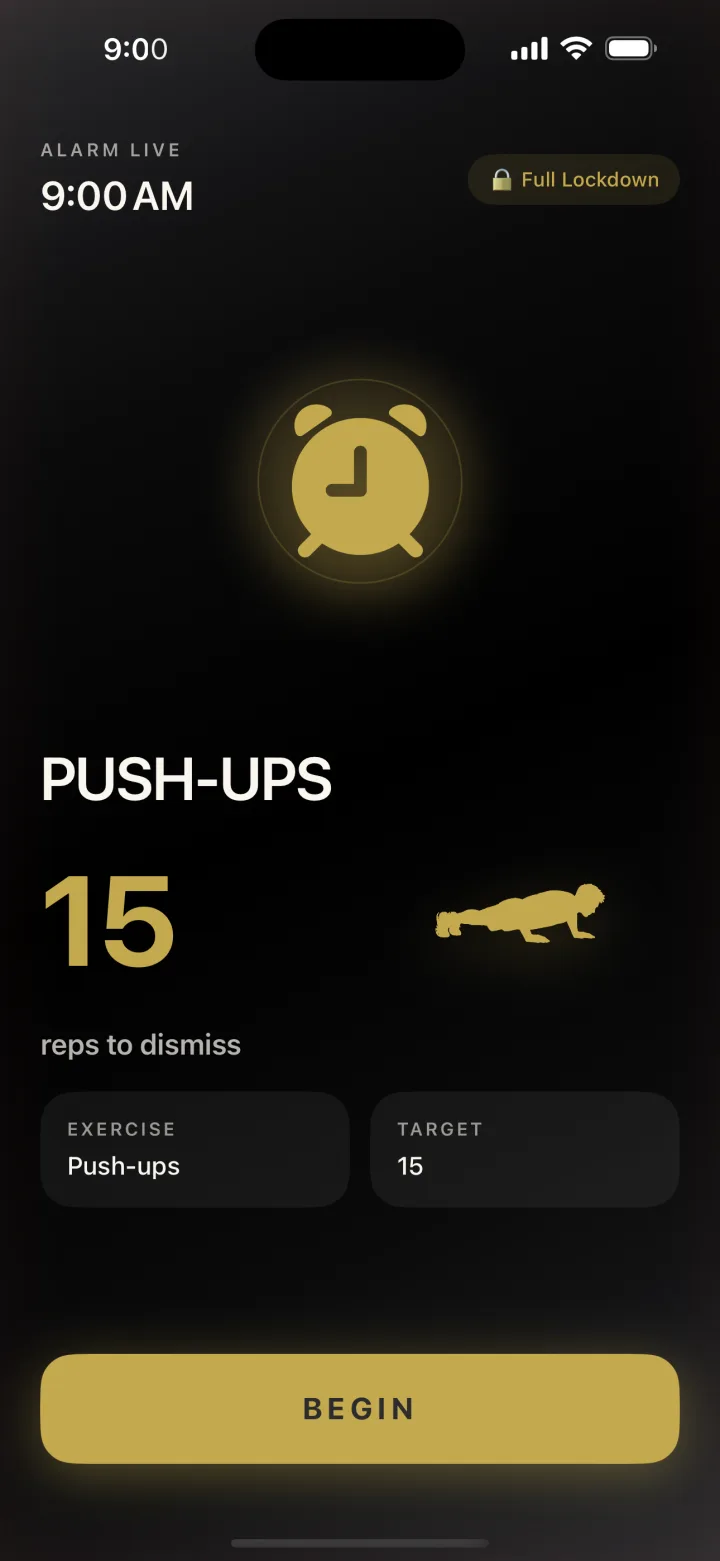
Push-ups, squats, or jumping jacks, counted by your camera. No snooze button. Nothing recorded or uploaded.
Why movement beats puzzles
That heavy, foggy feeling right after you wake up has a name: sleep inertia. According to the Sleep Foundation, it generally lasts 15 to 60 minutes and can stretch longer. During that window, your judgment is at its worst. That's exactly when a snooze button asks you to make a decision.
Puzzles try to out-think sleep inertia. Movement shortens your exposure to it. In a 2021 study in Physiology & Behavior, people who did a 30-second burst of high-intensity exercise after waking reported feeling less sleepy than when they didn't exercise. To be fair to the data, their test scores didn't improve, and it was a small study. But "I feel awake enough not to crawl back into bed" is precisely the job an alarm has.
One more honest note. Snoozing itself isn't necessarily harmful: a 2023 study in the Journal of Sleep Research found that about 30 minutes of snoozing didn't hurt sleep or mood in habitual snoozers. The real cost is what you meant to do with that half hour: the workout, the quiet coffee, the train you keep missing. An alarm that makes you get up protects that time.
How a push-up alarm works (using RiseReps as the example)
RiseReps is an iPhone alarm built around the #1 approach above. Here's what happens when it goes off:
- The alarm fires, with no snooze button. No tap-to-dismiss either.
- You prop up your phone and start your set. On-device pose detection tracks your body and counts each rep in real time. Video never leaves your phone; nothing is recorded or uploaded.
- The alarm stops when the last rep is counted. Your streak logs itself, and you're already standing.
A few details make it hard to wriggle out of:
- Persistent mode re-fires the alarm every 60 seconds if you close the app.
- Full Lockdown blocks your other apps until the workout is done, so you can't escape into your feed.
- Built-in progression nudges your rep count up each week, so the morning workout grows with you.
- An accountability partner can see your streak, with one nudge a day if you sleep in.
You choose the exercise. Push-ups if you want the hardest wake-up, squats if your wrists or shoulders need a break, jumping jacks for the fastest jolt.
Which alarm that makes you get up should you pick?
- You sleep through everything and snooze on autopilot: an exercise-verified alarm. It's the only type you can't finish horizontal.
- You just need to break the "off in bed" reflex: a photo or QR mission, or start with your phone across the room.
- You share a bedroom: skip the rolling gadget. A short set of squats beside the bed is quieter than chasing a clock across the floor.
- You want a morning workout habit anyway: let the alarm be the workout. Ten push-ups a day, every day, adds up to thousands of reps a year with zero extra willpower.
Make any of them stick: start with a rep count or task you could do sick and tired (10 squats beats 50 push-ups you'll skip), set the alarm the night before, and keep your phone stand in the same place every night so there's nothing to figure out at 6 AM.
FAQ
Is there an alarm clock that makes you get out of bed?
Yes. Some alarm apps only turn off after a physical task: scanning a QR code in another room, walking a set number of steps, or doing exercise reps the camera counts. Rolling alarm clocks do it with hardware. The hardest to cheat are exercise-verified alarms like RiseReps, which require camera-counted push-ups, squats, or jumping jacks.
Is there an alarm that makes you do push-ups to turn it off?
Yes. RiseReps stays on until your iPhone camera counts a set number of push-ups, squats, or jumping jacks. Rep counting runs on-device, so no video is recorded or uploaded, and there's no snooze button.
What's the best alarm app for heavy sleepers?
One you can't turn off lying down. Apps that require physical movement, like photo missions or camera-verified exercise, beat louder sounds and math puzzles because they get your body upright and moving before the alarm stops.
Can you cheat an alarm that makes you get out of bed?
Most can be cheated a little. Puzzles and shake alarms can be done in bed, and photo or QR missions only require a walk to one spot. Camera-verified exercise is the hardest to fake: the alarm only stops after a full set is counted, and strict modes can re-fire the alarm or lock other apps if you quit early.
Is hitting snooze actually bad for you?
Not necessarily. A 2023 study found about 30 minutes of snoozing didn't harm sleep or mood in habitual snoozers. The bigger cost is practical: snoozing eats the time you wanted for a workout, a calm morning, or getting out the door on time.
Sources
- Sundelin T., Landry S., Axelsson J. (2023). Is snoozing losing? Journal of Sleep Research. Summarized by Sleep Foundation and PsyPost.
- Kovac K. et al. (2021). The impact of a short burst of exercise on sleep inertia. Physiology & Behavior. Abstract.
- Sleep Foundation. Sleep inertia (updated July 2025).