If you want to know how to stop hitting snooze, start here: you're not lazy, and you're not alone. The fix isn't more willpower at 6 AM. It's setting things up the night before so the snooze button stops being an option, then giving your body something to do in the first minute that makes going back to bed feel pointless.
How common is it? A 2025 study in Scientific Reports looked at about 3 million nights of sleep data from more than 21,000 people. Roughly 56% of sleep sessions ended with a snooze, and snoozers spent an average of 11 minutes a morning bouncing between alarms.
To stop hitting snooze: get enough sleep (at least 7 hours for most adults), set one alarm for the time you'll actually get up, turn the snooze option off, and use an alarm that requires you to stand up and move before it stops, like walking to your phone or doing a set of camera-counted reps. Remove the button and the habit has nothing to grab onto.
Why you keep hitting snooze
Most advice skips this part, which is why most advice fails. Snoozing usually comes from some mix of three things:
- You're short on sleep. The CDC recommends at least 7 hours a night for adults aged 18 to 60, and about 1 in 3 American adults don't regularly get it. If your body is owed sleep, it will try to collect at 6 AM.
- Your brain is still half offline. The groggy, heavy feeling right after waking is called sleep inertia. It's the worst possible moment to make a decision, and the snooze button asks you to make one.
- The button is right there. Snooze is one tap away, rewards you instantly, and has no visible cost. That's a habit loop working exactly as designed.
You can't fix the second one with grit. You can fix the first and third, and you can shorten the second by moving. That's what the fixes below are built around.
Is snoozing actually bad? The honest answer
Plenty of articles claim snoozing wrecks your whole day. The research is more mixed than that, and you deserve the real picture.
In a 2023 study in the Journal of Sleep Research, Tina Sundelin and colleagues had 31 habitual snoozers spend nights in a sleep lab. Thirty minutes of snoozing didn't hurt their sleep, mood, or morning cortisol, and they did slightly better on some cognitive tests right after waking. Their survey of 1,732 people found 69% snooze or set multiple alarms at least sometimes.
The 2025 Scientific Reports team saw it differently: the hours just before waking are rich in REM sleep, and snoozing breaks that sleep into fragments. Their advice was simple. Set your alarm for the latest time you can, and get up when it first goes off.
So here's the fair summary. A few minutes of snoozing probably won't hurt you. The real cost is practical: the morning workout you skip, the rushed shower, the train you miss, and the feeling of starting the day already behind. If you're reading this, that cost is probably why.
How to stop hitting snooze: 11 fixes
They're grouped by when you use them. You don't need all eleven. Pick two or three from different groups and stack them.
1. Protect your 7 hours first
Count back from your wake time and pick a real bedtime. If you need to be up at 6:30, lights out by 11:30 at the latest. No alarm trick beats a body that's running on 5 hours. If you're chronically short, the fixes below will feel like a fight every single morning.
2. Keep the same wake time, weekends included
The study above found snoozing is heaviest Monday through Friday and lowest on weekends. A huge Saturday lie-in makes Monday's alarm feel like jet lag. Keep your weekend wake time within about an hour of your weekday one and the 6 AM alarm stops feeling like an ambush.
3. Set one alarm, for the time you'll actually get up
If you set an alarm for 6:00 "knowing" you'll get up at 6:30, you've built snooze into the plan. Your brain knows it too. Set a single alarm for the real time. You get those 30 minutes as solid, unbroken sleep instead of three fragments.
4. Decide tonight what the first 60 seconds look like
Your 6 AM self is a bad negotiator. So don't let them negotiate. Write the script the night before: "Alarm goes off, feet on the floor, phone stand, ten squats, curtains open." When there's nothing left to decide, there's nothing to argue about.
5. Turn off snooze on your iPhone
Snooze is on by default for every new alarm. To switch it off, open the Clock app, go to the Alarm tab, tap an alarm, toggle Snooze off, and tap Save. For a Sleep Schedule wake-up alarm, tap Change under Sleep | Wake Up in the Clock app and switch snooze off there (step-by-step guide).
One warning. Since iOS 26, you can set a custom snooze length from 1 to 15 minutes per alarm. That sounds helpful. In practice, a 15-minute snooze just means fewer, longer fragments. If you're serious about quitting, leave snooze off rather than tuning it.
6. Put your phone across the room
The classic for a reason: you can't hit snooze from bed if the phone isn't in reach. It works best when the phone lands somewhere that also starts your morning, like next to the bathroom door. Its weak spot is that turning it off takes one second, and your warm bed is three steps away.
7. Use an alarm that won't stop until you move
This is the fix that closes the loophole in #6. Some alarms only stop after a physical task, like scanning a code in another room or doing a set of exercise reps. We compared every type in Alarm Clock That Makes You Get Out of Bed: 7 Types Ranked. The short version: anything you can do lying down (math puzzles, shaking the phone) gets beaten within a week. Movement-based alarms don't.
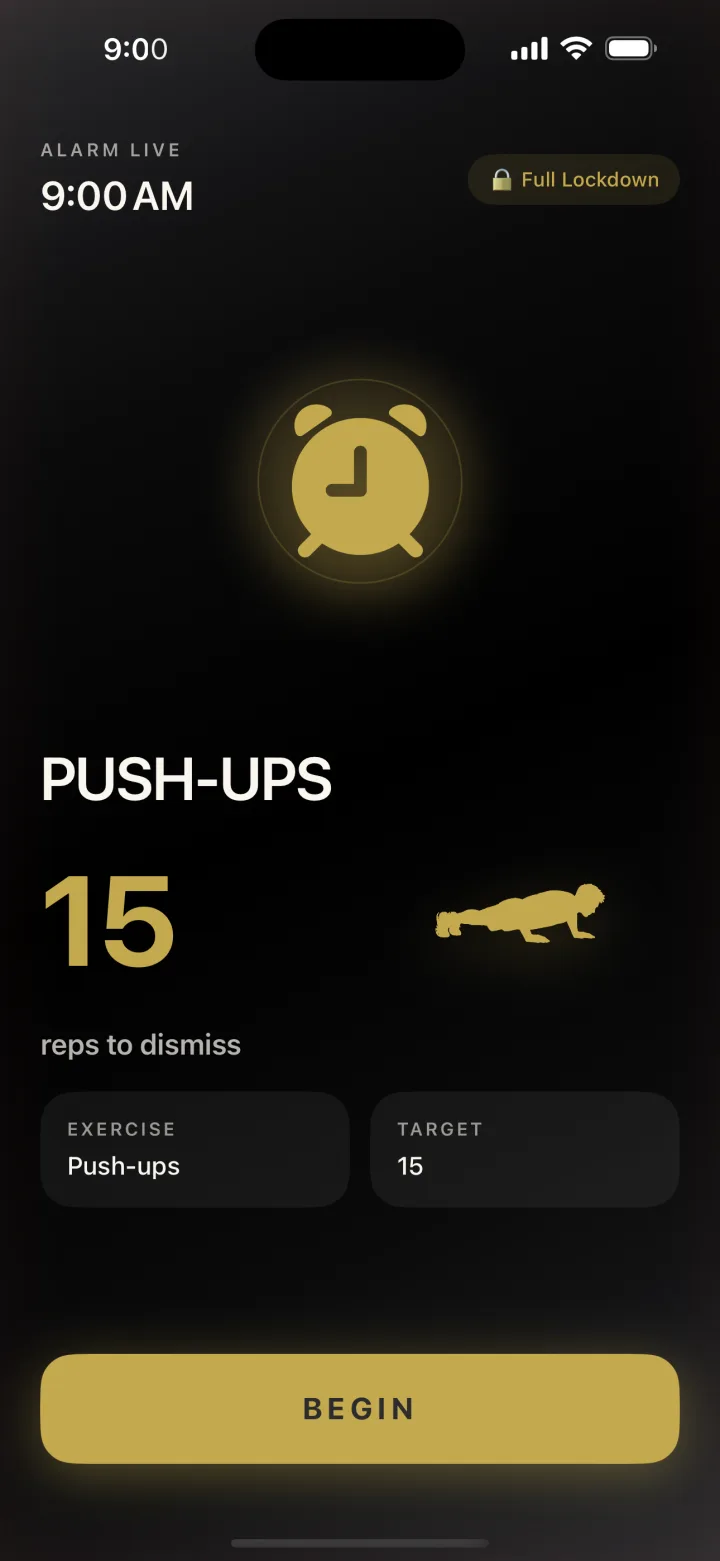
Push-ups, squats, or jumping jacks, counted by your iPhone camera with on-device pose detection. Nothing recorded or uploaded.
8. Feet on the floor before you think
The moment the alarm goes off, sit up and put both feet on the floor. Don't check the time, don't check your phone, don't ask yourself how you feel. Lying down, the bed wins. Sitting up, you've already changed the question from "should I get up?" to "what's next?"
9. Get light in your eyes
Open the curtains or switch on the brightest light in the room. Light is one of the strongest signals your body clock uses to know it's daytime. A dark bedroom at 6 AM is basically an invitation to keep sleeping.
10. Move hard for 30 seconds
This is the most underrated fix on the list. In a small 2021 study in Physiology & Behavior, 15 people woke from a nap and then did either a 30-second all-out cycling sprint, 30 seconds of easy cycling, or nothing. They felt least sleepy after the sprint. Their cognitive test scores didn't change, so this isn't magic. But feeling awake enough not to crawl back into bed is exactly the job here.
You don't need a bike. Ten push-ups, fifteen squats, or thirty seconds of jumping jacks beside your bed will get your heart rate up. It's also why exercise-verified alarms work: the thing that turns off the alarm is the same thing that wakes you up. (Here's how to set up an alarm that makes you do push-ups.)
11. Track your streak and tell someone
Quitting snooze is a habit, and habits like a scoreboard. Mark each no-snooze morning on a calendar or in an app and watch the streak grow. Then add one person who'll notice when it breaks. A friend who texts "you up?" is surprisingly hard to ignore. Start small, too: one no-snooze morning beats a perfect plan you abandon by Thursday.
A 7-day plan to quit snoozing
Here's how to stack the fixes without overhauling your life overnight:
| Day | Add this | Why |
|---|---|---|
| 1 | Pick a wake time and a bedtime 7.5+ hours earlier | Fixes the sleep debt behind most snoozing |
| 2 | Delete backup alarms, keep one, turn snooze off | Removes the button the habit runs on |
| 3 | Move your phone (or phone stand) out of reach | Forces you upright to stop the alarm |
| 4 | Feet on the floor, then curtains open | Light and posture tell your body it's morning |
| 5 | Add 10 to 15 reps before anything else | Movement cuts the groggy pull back to bed |
| 6 | Start a streak and tell one person | Gives the habit stakes and a scoreboard |
| 7 | Keep the same wake time on the weekend | Stops Monday from feeling like jet lag |
Or let the alarm do the work
Fixes 5, 6, 7, 10, and 11 all do the same thing: they take the decision away from your groggy self. RiseReps rolls them into one iPhone alarm, so you're not relying on discipline at 6 AM:
- No snooze button and no tap-to-dismiss. The alarm only stops after your camera counts a full set of push-ups, squats, or jumping jacks. Pose detection runs on your phone, so video never leaves it.
- Persistent mode re-fires the alarm every 60 seconds if you close the app and bail.
- Full Lockdown blocks your other apps until the workout is done, so you can't slip into your feed instead.
- Streaks and stats track your wake time, reps, and longest streak, and built-in progression can raise your reps each week.
- An accountability partner sees your streak and can send one nudge a day if you sleep in.
It's free to download with a free trial, so you can test it against your own snooze habit this week.
The one rule that matters most: make the alarm impossible to dismiss from a lying position. Every other fix gets easier once your feet are already on the floor.
FAQ
Why can't I stop hitting snooze?
Usually it's a mix of too little sleep, grogginess right after waking (sleep inertia), and a snooze button that's one tap away. Fix the sleep debt, set one alarm for the time you'll actually get up, turn snooze off, and use an alarm you can't dismiss lying down.
Is hitting snooze bad for you?
Not necessarily. A 2023 study in the Journal of Sleep Research found 30 minutes of snoozing didn't harm sleep, mood, or morning cortisol in habitual snoozers. Other researchers point out that snoozing fragments the REM-rich sleep just before waking. The bigger cost for most people is practical: snoozing eats the time they wanted for a workout or a calm start.
How do I turn off snooze on my iPhone?
Open the Clock app, go to the Alarm tab, tap the alarm, switch the Snooze toggle off, and tap Save. Snooze is on by default for every new alarm, so repeat this for each one. For a Sleep Schedule wake-up alarm, tap Change under Sleep | Wake Up and turn snooze off there.
How do I stop hitting snooze and actually get up?
Put both feet on the floor the moment the alarm goes off, open the curtains, and move for 30 seconds, such as 10 push-ups or 15 squats. An alarm that only stops after you stand up and move, like a QR mission or a camera-verified exercise alarm, makes this automatic.
What's the best alarm to stop hitting snooze?
One you can't dismiss from bed. Math puzzles and shake-to-stop alarms can be done half-asleep. Movement-based alarms work better. RiseReps, for example, has no snooze button and only stops after your iPhone camera counts a set of push-ups, squats, or jumping jacks.
Sources
- Robbins R. et al. (2025). Snooze alarm use, Scientific Reports. Summarized by Mass General Brigham.
- Sundelin T., Landry S., Axelsson J. (2023). Is snoozing losing? Journal of Sleep Research. Summarized by PsyPost.
- Kovac K. et al. (2021). The impact of a short burst of exercise on sleep inertia. Physiology & Behavior. Abstract.
- Centers for Disease Control and Prevention (2016). 1 in 3 adults don't get enough sleep.
- WebNots. How to disable snooze in iPhone alarm; 9to5Mac. iOS 26 snooze options.