Jumping jacks are the exercise everyone learned in gym class and then forgot about. No equipment, no gym, no learning curve. Just jump, clap, repeat.
Search for jumping jacks benefits and you'll find lists claiming they do everything from melting belly fat to fixing your skin. Some of that is real. A lot of it isn't. This guide sorts the benefits by how good the evidence is, works out what they actually burn, answers how many jumping jacks a day you should do, and covers the use most lists skip: getting you out of bed in the morning.
What are the benefits of jumping jacks? Done briskly, jumping jacks count as vigorous cardio: the 2024 Compendium of Physical Activities rates vigorous calisthenics like jumping jacks at 7.5 METs, which counts as vigorous intensity. Short bursts add up, the impact can help bone density, and a quick set after waking can make you feel less sleepy. They won't build much muscle or burn fat from one spot. A good start: 2 to 5 minutes a day in short sets, building toward 10.
Jumping jacks benefits, ranked by how good the evidence is
Almost nobody studies jumping jacks by name. Researchers study what jumping jacks are: vigorous bodyweight cardio, short bursts of hard effort and repeated impact. That research is solid, so here's what it says, strongest first.
1. Is jumping jacks cardio? Yes, and vigorous cardio
The Compendium of Physical Activities is the standard reference researchers use to estimate how hard activities are. Its 2024 edition (Herrmann, Willis and Ainsworth, Journal of Sport and Health Science, 2024) lists "calisthenics (e.g., pushups, sit ups, pull-ups, jumping jacks, burpees, battling ropes), vigorous effort" at 7.5 METs. One MET is roughly the energy you burn sitting still, so a brisk set of jumping jacks works you about seven and a half times harder than sitting on the couch.
That matters for the official targets. The CDC's adult guidelines call for 150 minutes a week of moderate activity or 75 minutes of vigorous activity, plus muscle strengthening on 2 or more days. Vigorous minutes count roughly double. And the CDC says you can break activity into smaller chunks; it doesn't have to happen all at once.
2. Short bursts count more than you'd think
This is where jumping jacks shine, because they're the easiest exercise to do for one minute anywhere.
In a 2022 study in Nature Medicine, Stamatakis and colleagues used wrist-worn activity trackers on 25,241 UK adults who didn't exercise. Those who logged about three short bursts of vigorous activity a day, each lasting 1 to 2 minutes, had a 38–40% lower risk of dying from any cause over about seven years, and a 48–49% lower risk of dying from cardiovascular disease, compared with people who logged none. That was everyday activity like stair climbing or fast walking, not workouts, and it's an observational study, so it can't prove cause and effect. But it's a strong hint that small doses of hard effort matter.
Controlled trials point the same way. A 2026 meta-analysis in The Journal of Nutrition, Health and Aging by Meng and colleagues pooled 21 randomized trials (921 adults) of "exercise snacks", short bouts spread through the day. They improved VO2max, the standard measure of aerobic fitness, with moderate-certainty evidence. Effects on body fat and blood fats were inconsistent, and the fitness gains showed up in under-50s but not clearly in over-50s.
So the honest version: a few minutes of jumping jacks a day can make you fitter. Don't count on them alone to change your body composition.
3. Impact can help your bones
Jumping loads your bones in a way that cycling and swimming don't. In a 2006 trial in the Journal of Applied Physiology, Kato and colleagues had young women do just 10 maximal vertical jumps a day, three times a week, for six months. Bone mineral density at the hip (femoral neck) and lower spine went up in the jump group and didn't change in the control group.
Jumping jacks are lower impact than maximal jumps, so don't expect identical results. But it's a good reason to keep some hopping in your week rather than doing only low-impact cardio, if your joints are happy with it.
4. They make you feel more awake
More on this below, because it's the benefit that matters most at 6am.
What muscles do jumping jacks work?
Jumping jacks mostly work your calves, quads, glutes and the muscles on the inside and outside of your hips, which open and close your legs. Your shoulders raise and lower your arms, and your core keeps you stable as you land.
Can jumping jacks build muscle?
Not much. Muscle grows when you push it close to its limit against a real load, and each jumping jack is easy on its own; what gets hard is your breathing, not your muscles. Expect better endurance in your legs and shoulders, not bigger ones. If you want strength, pair jumping jacks with push-ups and squats. Our guide to 100 push ups a day covers what push-up training really builds.
Jumping jacks benefits for weight loss: calories burned
The Compendium defines one MET as about 1 kcal per kilogram of body weight per hour. At 7.5 METs, you can estimate what a brisk session burns:
| Body weight | Per minute | 5 minutes | 10 minutes |
|---|---|---|---|
| 60 kg (132 lb) | ~7.5 kcal | ~38 kcal | ~75 kcal |
| 70 kg (154 lb) | ~9 kcal | ~44 kcal | ~88 kcal |
| 90 kg (198 lb) | ~11 kcal | ~56 kcal | ~113 kcal |
These are rough estimates, not measurements. They include the energy you'd burn anyway sitting still, they assume a genuinely brisk pace, and your real number depends on your fitness and how high you jump.
100 jumping jacks a day: how many calories?
It depends on your pace. By our rough count, 100 brisk jumping jacks take most people a minute and a half to two minutes, so roughly 10 to 20 kcal. Time yourself and use the table. That's a small number, which is the point: jumping jacks help weight loss by making you fitter and more active, not by burning a lot in one go. Food matters far more for the number on the scale.
Do jumping jacks burn belly fat?
Not specifically. No exercise picks where your body takes fat from. Jumping jacks burn energy like any cardio, and where you lose fat first is mostly down to your body, not the exercise.
How many jumping jacks a day should I do?
There's no official number. Here's our rule of thumb, built around minutes rather than reps, since your pace changes as you get fitter:
| Where you are | Daily target | How to split it |
|---|---|---|
| New to exercise | 2–3 minutes (about 100–150 reps) | Sets of 20–30 with a breather between |
| Somewhat active | 5 minutes (about 250–300 reps) | 3–5 sets, or one in the morning and a few through the day |
| Fit and want more | 10 minutes or intervals | 30 seconds hard, 30 seconds easy, or mix in squats and push-ups |
For perspective: about 11 minutes of vigorous activity a day gets you to the CDC's 75 vigorous minutes a week on its own. You don't need to do it all as jumping jacks, and you shouldn't. Mix them with walks, runs, bike rides or anything you'll keep doing.
Is it good to do jumping jacks everyday?
For most healthy adults, a few minutes a day is fine, and daily is easier to stick with than "three times a week". The catch is impact. If your knees, shins, ankles or feet start to ache, swap in the low-impact version below for a few days, or alternate with squats. Ramping up slowly is the best way to avoid the shin pain that comes from jumping too much too soon.
Is 100 jumping jacks a day good?
As a starting habit, yes. It's one or two minutes, it gets your heart rate up, and it's a lot better than nothing. Once 100 feels easy, don't just keep adding reps forever. Go faster, add a set or two through the day, or swap one set for something harder like squat jumps. The same plateau logic we cover for push ups every day applies here.
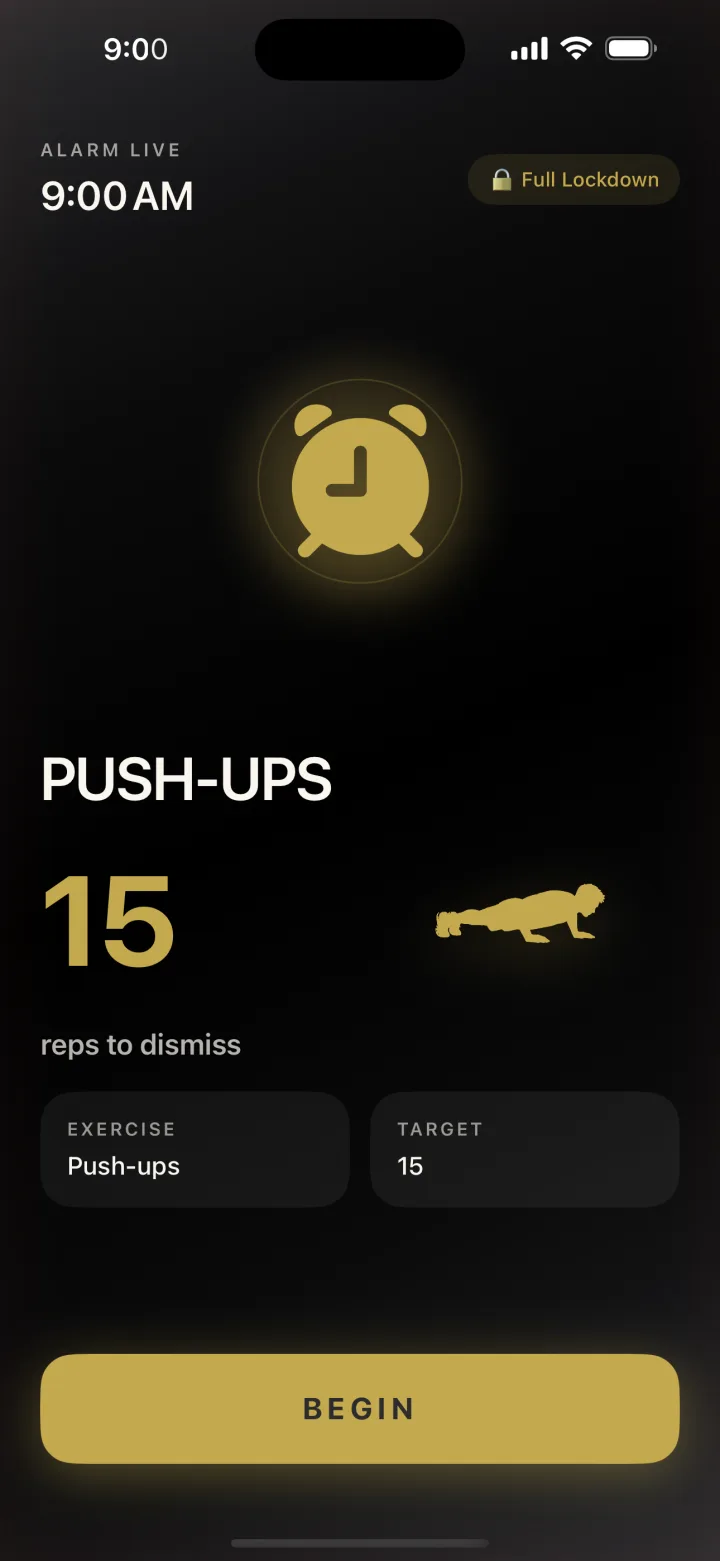
RiseReps only goes quiet when your iPhone's camera counts your jumping jacks, push-ups or squats. No snooze, no tap-to-dismiss, and Persistent mode re-fires every 60 seconds if you bail. Counting happens on your device, nothing uploaded.
Benefits of jumping jacks in the morning
Right after you wake up, your brain runs slow for a while. Sleep researchers call it sleep inertia, and it's the reason the snooze button feels like such a good idea at 6:30.
A short burst of movement helps you feel less sleepy. In a 2021 study in Physiology & Behavior, Kovac and colleagues woke 15 adults from a nap and had them do 30 seconds of hard cycling, 30 seconds of easy cycling or nothing. People felt least sleepy after the hard sprint, then after the easy one, and most sleepy after doing nothing. One honest caveat: their scores on thinking and reaction-time tests didn't improve. The exercise made them feel more awake, not perform better.
That's still exactly what you need at the moment that matters. The hard part of the morning isn't thinking clearly. It's not crawling back under the covers. Thirty seconds of jumping jacks gets you vertical, raises your heart rate and makes going back to sleep feel a lot less tempting. It's the same idea as our guide on how to get out of bed in the morning: make the first move physical, before your brain starts negotiating.
Jumping jacks are also the most practical morning exercise. No floor space for a push-up, no warm-up, and you can do them in pajamas next to the bed. If you're weighing a morning routine against evening workouts, our guide to working out in the morning breaks down the research.
Turn your alarm into a jumping jacks alarm
The problem with "I'll do jumping jacks when I wake up" is that the version of you who makes that promise isn't the one who has to keep it. RiseReps takes the decision away. When your alarm fires, your iPhone's camera counts your jumping jacks (or push-ups or squats) using on-device pose detection, and the alarm only stops when your reps are done. There's no snooze button and no tap-to-dismiss. Persistent mode re-fires the alarm every 60 seconds if you close the app, and optional Full Lockdown blocks your other apps until you finish.
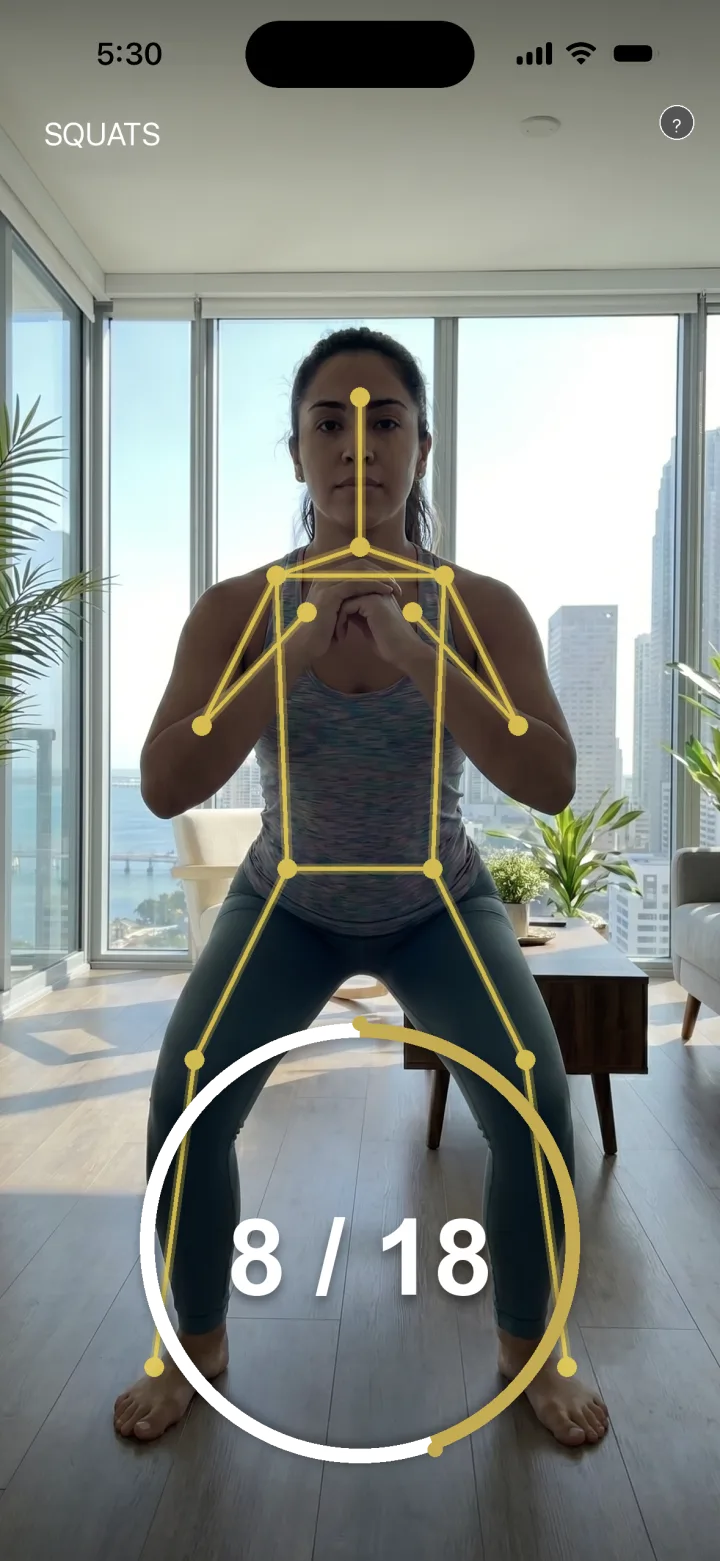
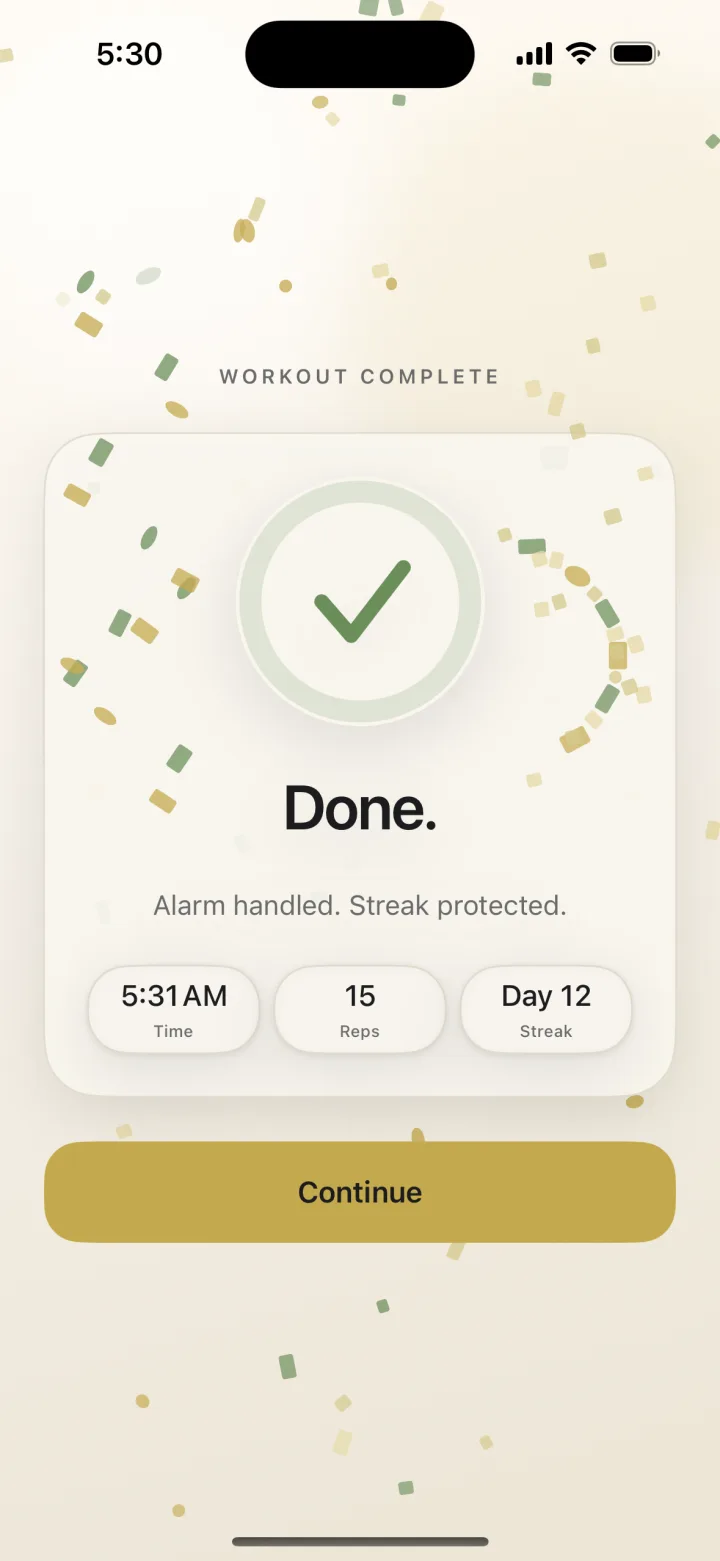
Built-in progression can raise your rep count each week, so a 20-rep set becomes a 40-rep set without you thinking about it, and your streak, wake times and completion rate log themselves. RiseReps is free to download on the App Store, and the alarm workouts need RiseReps Pro, a single annual subscription.
How to do jumping jacks (and a low-impact version)
- Stand tall, feet together, arms by your sides, a slight bend in your knees.
- Jump your feet out to a bit wider than your shoulders while you swing your arms out and up overhead.
- Jump back to the start, arms back down.
- Land softly on the balls of your feet, then let your heels touch. Quiet landings are easier on your joints.
Keep a steady rhythm. Faster is harder, but sloppy is pointless.
Low-impact jumping jacks (step jacks)
No jump: step one foot out to the side while you raise your arms, step it back, then switch sides. Speed it up and it still gets your heart rate up. Good for sore knees, a heavy chest or belly, the first week back after a break, or a downstairs neighbor at 6am.
Are jumping jacks bad for you?
For most people, no. But they're a jumping exercise, and jumping isn't for everyone on every day:
- Joint pain. If jumping hurts your knees, hips, ankles or feet, use step jacks and get the pain checked if it doesn't settle.
- Leaking when you jump. It's common, especially after pregnancy, and it's worth raising with a doctor or a pelvic floor physiotherapist instead of just putting up with it.
- Heart, lung or balance problems, pregnancy or a recent injury. Check with a doctor before adding vigorous exercise.
- Doing too much too soon. Jumping from zero to 1,000 a day is the classic way to end up with sore shins. Build up over weeks.
If anything feels wrong, like chest pain, dizziness or unusual shortness of breath, stop and get medical advice.
Jumping jacks vs running and jump rope
Running and jump rope can be just as intense and are easier to do for longer, but they need space, shoes or a rope. Jumping jacks win on convenience: you can do them anywhere, in a minute, with zero setup. That's why they make such a good "exercise snack" and such a good morning starter.
A 4-week jumping jacks plan
Do this in the morning, right after the alarm. Rest as long as you need between sets.
| Week | Morning set | Extra through the day |
|---|---|---|
| 1 | 2 sets of 20 | None |
| 2 | 2 sets of 30 | One set of 30 in the afternoon |
| 3 | 3 sets of 30 | Two sets of 30 |
| 4 | 3 sets of 40 | Two sets of 40 (that's 200 a day) |
If week 2 feels rough, repeat it. If week 1 is easy, start at week 2. After week 4, keep the morning set as your wake-up and add harder work, like intervals or squats and push-ups, instead of chasing a bigger number.
FAQ
Are jumping jacks good cardio?
Yes. The 2024 Compendium of Physical Activities rates vigorous calisthenics such as jumping jacks at 7.5 METs, which counts as vigorous-intensity activity. Done briskly for a few minutes, they get your heart rate and breathing up fast.
How many jumping jacks a day should I do?
There is no official number. A good start for most people is 2 to 3 minutes a day (about 100 to 150 jumping jacks) in short sets, building toward 5 to 10 minutes over a few weeks. Spread them through the day if that's easier.
Is it good to do jumping jacks everyday?
For most healthy adults, a few minutes a day is fine. Build up slowly, and if your knees, shins or feet ache, switch to low-impact step jacks for a few days. Check with a doctor first if you have joint, heart or balance problems, are pregnant or are recovering from an injury.
Do jumping jacks burn belly fat?
Not specifically. No exercise burns fat from one spot. Jumping jacks burn energy like other cardio, roughly 7 to 11 kcal a minute at a brisk pace depending on your weight, and losing belly fat depends far more on your overall activity and diet.
Can jumping jacks build muscle?
Not much. They build endurance in your legs, hips and shoulders, but each rep is too light to drive much muscle growth. Pair them with push-ups and squats if you want strength.
Sources
- Herrmann S. D., Willis E. A., Ainsworth B. E., et al. (2024). 2024 Adult Compendium of Physical Activities: a third update of the energy costs of human activities. Journal of Sport and Health Science, 13. Conditioning exercise MET values.
- Centers for Disease Control and Prevention. Adult Activity: An Overview. cdc.gov.
- Stamatakis E., Ahmadi M. N., Gill J. M. R., et al. (2022). Association of wearable device-measured vigorous intermittent lifestyle physical activity with mortality. Nature Medicine, 28. Full text.
- Meng L., Li Y., Chen J., Zheng H. (2026). Effects of exercise snacks on cardiorespiratory fitness, body composition, and blood lipids in adults across different age groups: a systematic review and meta-analysis. The Journal of Nutrition, Health and Aging, 30. Full text.
- Kato T., Terashima T., Yamashita T., Hatanaka Y., Honda A., Umemura Y. (2006). Effect of low-repetition jump training on bone mineral density in young women. Journal of Applied Physiology, 100. Abstract.
- Kovac K., Vincent G. E., Paterson J. L., et al. (2021). The impact of a short burst of exercise on sleep inertia. Physiology & Behavior, 242. Abstract.