The alarm goes off. You hear it. You even know what it means. And yet your brain feels like it's loading through wet sand, your body weighs twice as much as it did last night, and the bed is making a very convincing argument. That's sleep inertia, and everyone gets it.
It's not laziness and it's not a disorder. It's a normal, measurable dip in how well your brain works right after waking. The catch is that it lands at exactly the moment your alarm asks you to make a decision. This guide covers what sleep inertia is, how long it lasts, why some mornings are worse, and how to get through it faster.
Sleep inertia is the grogginess and slowed thinking you feel right after waking. It's worst in the first few minutes, usually eases within 15 to 60 minutes, and can linger longer after short sleep. To shake it faster: get enough sleep, keep a steady wake time, stand up and move right away, get daylight, and use an alarm you can't switch off from bed. If it drags on all day, talk to a doctor.
What is sleep inertia?
Sleep inertia is the transition zone between being asleep and being properly awake. Your eyes are open, but parts of your brain are still running in sleep mode. Reaction time, memory and judgment all lag for a while.
How big is that lag? In a 2006 study in JAMA, Wertz, Ronda, Czeisler and Wright tested nine healthy volunteers who had been sleeping eight hours a night. According to the University of Colorado's summary of the study, their thinking right after waking was worse than after going without sleep for more than a full day. These were well-rested people who had done the test hundreds of times.
Nobody knows for sure why it happens. The Sleep Foundation notes that one idea is that it's protective: a brake that helps you stay asleep through small, unwanted wake-ups. Useful at 3 a.m. Less useful at 6:30 when you have a train to catch.
You'll also see it called morning grogginess or, in its heavier, longer form, "sleep drunkenness."
Sleep inertia symptoms
You probably know these already. They just rarely get named:
- Grogginess and heavy limbs. The most common one. Getting vertical feels like a big ask.
- Slow, foggy thinking. Simple sums, reading a message, remembering what day it is.
- Poor judgment. "Ten more minutes won't matter" sounds completely reasonable.
- Clumsiness and slow reactions. Stubbed toes, dropped phones, the slow walk to the bathroom.
- A strong pull back to sleep. Lying back down feels like the obvious move.
- Autopilot actions. Familiar moves like tapping Stop still work fine, which is why you can turn off an alarm and not remember it. We dig into that in Why Do I Sleep Through My Alarms?
Notice the pattern. The parts of you that need careful thought are offline. The parts that run on habit are fine. That's the whole snooze problem in one sentence.
How long does sleep inertia last?
Short version: the worst of it is over in minutes, but a milder fog can hang around for an hour or more.
In the Wertz study, the most severe impairment showed up in the first three minutes after waking. The worst effects faded within about 10 minutes, but some effects could still be measured for up to two hours.
A 2019 review in Nature and Science of Sleep by Hilditch and McHill pulls the research together. Many studies found performance back to normal within 15 to 30 minutes. One found impairment on an addition task lasting up to 3.5 hours, although the authors point out that the body's natural rise in morning alertness makes that study hard to read. After a run of short nights, performance right after waking was about 10% worse, and it still hadn't recovered after 70 minutes.
The Sleep Foundation and Cleveland Clinic both put the usual range at 15 to 60 minutes. So if you feel human by the time you've showered and had breakfast, that's normal.
| Time after waking | What's typically going on |
|---|---|
| 0 to 3 minutes | Peak fog. Worst moment to make any decision, including about snooze. |
| Up to ~10 minutes | The worst effects ease off in rested people. |
| 15 to 60 minutes | Most people feel close to normal somewhere in here. |
| 1 to 2+ hours | Milder effects can linger, especially after short sleep or waking at a bad time for your body clock. |
Sleep inertia causes: why some mornings are worse
Everyone gets sleep inertia. But it's not the same every day, and a few things reliably make it heavier.
Not enough sleep
This is the clearest one in the research. The Hilditch and McHill review found sleep inertia gets worse after partial sleep loss and after long stretches awake. If you're running on six hours a night, your mornings will feel heavier than they need to.
Waking at the wrong time for your body clock
Sleep inertia is strongest when you wake near the low point of your internal clock, which for most people is in the early hours of the morning. If you're a natural night owl, a 6 a.m. alarm can land in what your body still treats as the middle of the night. Our guide on how to wake up early covers how to shift that clock earlier.
Waking from deep sleep (maybe)
You'll read everywhere that waking from deep sleep causes worse grogginess. Some studies support that. Others don't. The 2019 review calls the link between sleep stage and sleep inertia "not robust." It's plausible, just less settled than most articles make it sound.
Long naps
Naps longer than about 30 minutes make it more likely you'll wake up groggy. Short naps are less likely to leave you foggy, though not guaranteed.
Alcohol and some medications
Cleveland Clinic lists alcohol and some medications, including antihistamines, benzodiazepines, opioids and beta-blockers, among things that can make waking up harder. Don't change a prescription on your own. If you suspect a medication, ask the doctor who prescribed it.
How to get rid of sleep inertia
One honest point before the list: you can't make sleep inertia vanish. The 2019 review found "no clear empirical evidence" that any after-waking trick removes its immediate effects. What you can do is make it lighter, shorter, and much less likely to cost you your morning.
1. Fix the sleep debt first
Boring, but it's the lever with the best evidence behind it. Aim for 7 or more hours. No alarm, light or supplement fully covers for chronic short nights.
2. Keep the same wake time, weekends included
A steady wake time teaches your body clock when morning is. The Sleep Foundation lists consistent wake times among its key ways to reduce morning grogginess. A Saturday lie-in pushes your clock later and makes Monday's alarm land at a worse time.
3. Get vertical in the first minute
The first three minutes are the worst, so don't spend them lying down weighing your options. Stand up first. Think later. The how to stop hitting snooze guide has more ways to make standing up automatic, and our guide on how to get out of bed in the morning walks through the first 60 seconds step by step.
4. Move, briefly and hard
This is the newest piece of research. In a 2021 lab study in Physiology & Behavior, Kovac and colleagues woke 15 people at 2 a.m. after a two-hour nap. They then did a 30-second hard bike sprint, a 30-second easy spin, or nothing. People felt least sleepy after the sprint, then the easy spin, then doing nothing. Their scores on thinking tests didn't improve, though.
So be realistic: a short burst of exercise makes you feel more awake, which is exactly what you need to stay out of bed. It won't make you sharper for your 9 a.m. meeting.

5. Get daylight soon after waking
Open the curtains, or better, step outside for a few minutes. To be fair to the evidence, the 2019 review found light after waking hasn't been shown to fix the immediate fog on objective tests, though one study found people felt more alert. Morning light is still worth it for a different reason: it helps set your body clock earlier, which makes future mornings easier.
6. Time your caffeine
Coffee helps, just not instantly. In the review, caffeine gum taken after waking shortened sleep inertia but didn't touch the worst early minutes. The strongest result was caffeine taken right before a short nap, which the authors describe as the most effective proactive countermeasure studied. That's useful for naps, less so for your morning alarm.
7. Pick a melodic alarm sound
In a 2020 study in PLOS ONE, McFarlane and colleagues surveyed 50 people about their alarm sounds. Those who rated their alarm as melodic reported less grogginess. It's a small, self-reported survey, so treat it as a hint, not a rule. Still, if your alarm is a harsh beep and you hate mornings, it's an easy thing to try.
8. Be smart about snooze
Here's a twist. In a 2024 study in the Journal of Sleep Research, Sundelin, Landry and Axelsson found that 30 minutes of snoozing cost habitual snoozers about 6 minutes of sleep. It also didn't hurt, and sometimes helped, their test scores right after getting up. The authors suggest a brief snooze may even ease sleep inertia for some people.
So snoozing isn't evil. The problem is what it turns into. If "a brief snooze" becomes six of them and you're late every day, snooze isn't easing your sleep inertia. Your sleep inertia is running your mornings.
9. Don't drive or decide anything big right away
Given how strong the early fog is, give yourself a few minutes before getting behind the wheel or answering the important email. That matters most for shift workers and anyone on call who gets woken suddenly.
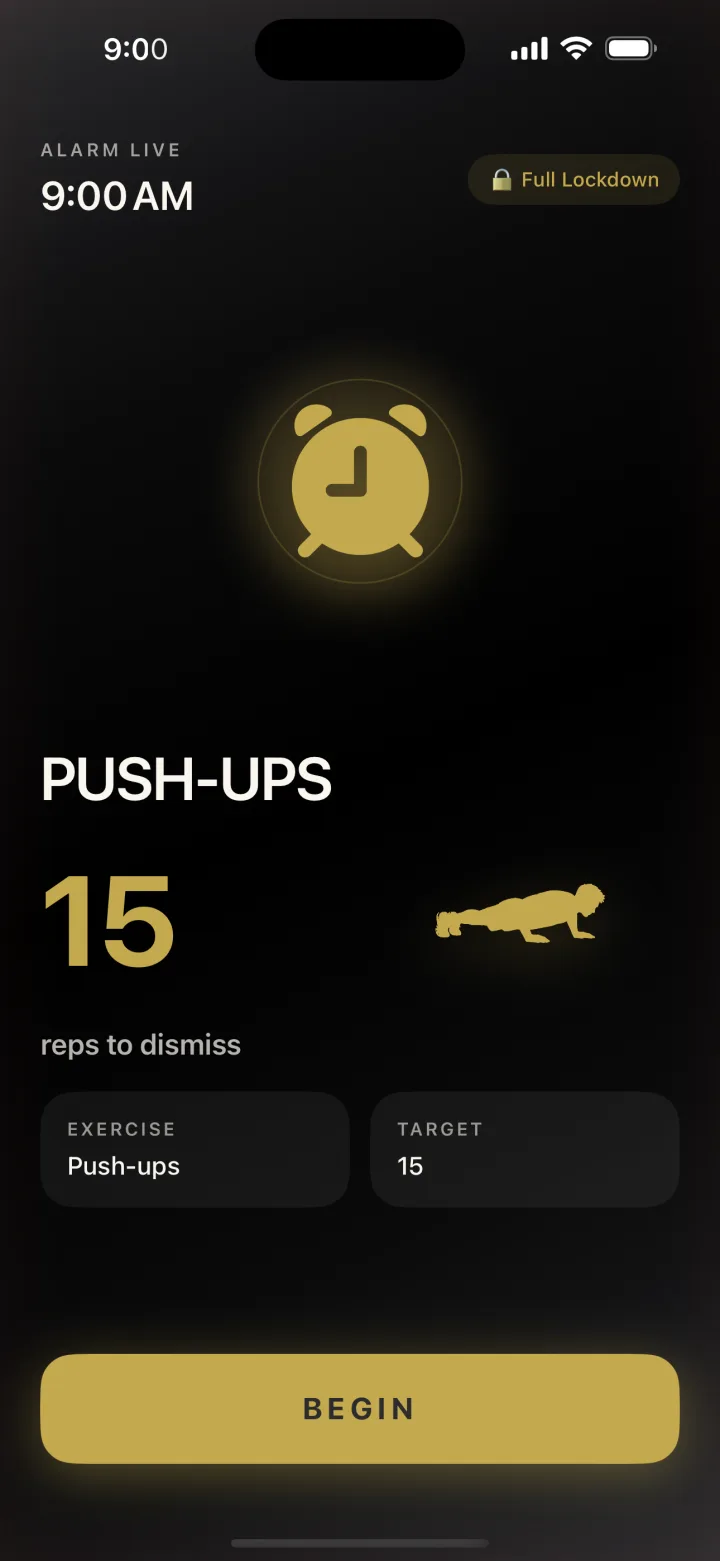
RiseReps only goes quiet when your iPhone's camera counts your reps. No snooze, no tap-to-dismiss, and Persistent mode re-fires if you bail. Nothing recorded or uploaded.
The best alarm for sleep inertia
People search for the best alarm for sleep inertia hoping for one that makes the fog disappear. No alarm can do that. What an alarm can do is decide what happens during the fog. There are two approaches.
Wake you more gently. Sunrise lamps and "smart" alarms that try to wake you in a lighter stage of sleep aim to make the wake-up feel softer. Given that the evidence on sleep stage is mixed, they may help some people more than others. Their weakness is the same as any normal alarm: you can still switch them off and roll over.
Get you moving through it. This approach accepts that the first few minutes will be foggy and makes sure you spend them on your feet. Our ranking of the alarm clocks that make you get out of bed covers the options, from putting your phone across the room to math, photo and exercise alarms. The pattern: anything you can do lying down, groggy-you eventually learns to do lying down.
That's why we built RiseReps around movement. When the alarm fires, your iPhone's camera counts a set of push-ups, squats or jumping jacks, and the alarm only stops when your reps are done. There's no snooze button and no tap-to-dismiss. Persistent mode re-fires the alarm every 60 seconds if you close the app, and optional Full Lockdown blocks your other apps until you finish. Counting uses on-device pose detection, so nothing is recorded or uploaded.
It lines up with what the research suggests: you're standing within the first minute, you get a short burst of movement while the fog is at its worst, and the snooze decision never comes up. You can also pick your alarm sound in settings if you want something more melodic. It's free to download on the App Store. For a deeper look at how rep-counting alarms work, see the alarm that makes you do push-ups.
Sleep inertia after a nap
Naps are where sleep inertia often feels worst, because you can drop into deep sleep and wake at a strange time of day. Keep naps to 30 minutes or less, set an alarm, and give yourself a few minutes before anything that needs focus. If you're napping to cover a short night, a brief coffee right before a short nap is the combo with the best research behind it.
Sleep inertia lasting all day? When to see a doctor
Normal sleep inertia fades within an hour or so, maybe a bit longer after a bad night. If you feel foggy until lunch most days, something else is usually going on. The most common reason is plain sleep debt. Try a couple of weeks of 7+ hours on a steady schedule and see what changes.
If it doesn't improve, it's worth talking to a doctor. Cleveland Clinic suggests seeing a sleep specialist if grogginess keeps lingering through the day and gets in the way of functioning. It also lists conditions that can make waking harder, including obstructive sleep apnea, delayed sleep phase syndrome, depression and idiopathic hypersomnia.
Signs it's worth a visit:
- You get 7+ hours and still feel foggy for hours most mornings.
- You often wake confused or disoriented, or have trouble waking at all.
- You're sleepy during the day, or nod off at your desk or while driving.
- Someone tells you that you snore loudly or stop breathing in your sleep.
None of that is something an alarm app can diagnose or fix. A doctor can.
FAQ
How long does sleep inertia last?
The worst of it is in the first few minutes after waking. For most people it eases within 15 to 60 minutes. Milder effects can last an hour or two, especially after short sleep or waking at a bad time for your body clock.
Can sleep inertia last all day?
Normal sleep inertia doesn't last all day. If you feel foggy for hours most mornings, the usual cause is not getting enough sleep. If grogginess lingers through the day even with 7+ hours on a steady schedule, see a doctor, since conditions like sleep apnea or idiopathic hypersomnia can make waking harder.
How do you fix sleep inertia?
You can't remove it completely, but you can make it shorter and lighter. Get enough sleep, keep the same wake time every day, stand up right away, do a short burst of movement, get daylight, and use an alarm you can't turn off from bed.
Does sleep inertia happen to everyone?
Yes. Sleep inertia is a normal part of waking up, not a disorder. How strong it feels varies with how much you slept, when you wake relative to your body clock, and things like alcohol or some medications.
Why does sleep inertia happen?
Scientists don't know for sure. Parts of the brain take time to switch from sleep to full wakefulness, and one theory is that this lag protects sleep during brief, unwanted wake-ups. It's stronger after sleep loss and when you wake near the low point of your body clock.
Sources
- Hilditch C. J., McHill A. W. (2019). Sleep inertia: current insights. Nature and Science of Sleep, 11, 155–165. Full text.
- Wertz A. T., Ronda J. M., Czeisler C. A., Wright K. P. (2006). Effects of sleep inertia on cognition. JAMA, 295(2), 163–164. University of Colorado summary.
- Kovac K., Vincent G. E., Paterson J. L., Reynolds A., Aisbett B., Hilditch C. J., Ferguson S. A. (2021). The impact of a short burst of exercise on sleep inertia. Physiology & Behavior, 242. Abstract.
- McFarlane S. J., Garcia J. E., Verhagen D. S., Dyer A. G. (2020). Alarm tones, music and their elements: Analysis of reported waking sounds to counteract sleep inertia. PLOS ONE, 15(1). Full text.
- Sundelin T., Landry S., Axelsson J. (2024). Is snoozing losing? Why intermittent morning alarms are used and how they affect sleep, cognition, cortisol, and mood. Journal of Sleep Research. Abstract.
- Sleep Foundation. Sleep inertia.
- Cleveland Clinic. Sleep inertia: what it is and how to get rid of it.