You're awake. You know you're awake. You know you should get up. And you're still lying there twenty minutes later, scrolling, or "resting your eyes," or negotiating with a snooze button you swore off last week.
Most advice on how to get out of bed in the morning is about motivation: find your why, think about your goals, make your bed. That's fine for 10 a.m. you. It does nothing for 6:30 a.m. you, who has the decision-making skills of a damp sock. This guide is built for that version of you: what's going on in your head, and the fixes that don't need willpower.
To get out of bed in the morning, decide the night before, not when the alarm rings. Put the alarm where you have to stand up to stop it, sit up and put your feet on the floor before you think, get light and a short burst of movement in the first few minutes, and leave your phone out of bed. If you're tired every morning, fix the sleep first: 7+ hours and the same wake time every day. If you can't get up most days no matter what, talk to a doctor.
Why is it so hard to get out of bed in the morning?
It's not a character flaw. A few things stack up at exactly the moment you need to move.
Your brain isn't fully online yet
The groggy stretch after waking is called sleep inertia, and it's stronger than most people think. In a 2006 study in JAMA, Wertz, Ronda, Czeisler and Wright tested well-rested volunteers right after waking. According to the University of Colorado's summary, the worst impairment came in the first three minutes, mostly faded within 10, and could still be detected for up to two hours. The same summary notes that areas like the prefrontal cortex, which handle problem solving and complex thought, take longer to come back online than other parts of the brain.
That's the part of you that knows getting up is a good idea. It's the last to arrive. We go deeper on this in Sleep Inertia: Why You Wake Up Groggy.
You're asking a groggy brain to make a decision
Here's the trap. The alarm goes off and you start weighing it: Do I really need to be up? What if I skip the gym? Ten more minutes is fine, right? Every one of those questions is answered by the least awake version of you. That version always votes for the bed.
The fix isn't more willpower. It's having fewer decisions to make in those first minutes.
You're short on sleep or your clock runs late
A 2019 review in Nature and Science of Sleep by Hilditch and McHill found that morning grogginess is made worse by prior sleep loss and by the time of day you wake. If you're sleeping six hours, or your body clock still thinks 6 a.m. is the middle of the night, getting up will feel like lifting a car. More on that below.
Bed is warm, the room is cold, and nothing's waiting
Comfort wins by default when the alternative is a cold floor and a to-do list. That sounds trivial, but it's a big reason winter mornings feel worse. Small changes to what's waiting for you can tip the balance.
How to get out of bed in the morning: the first 60 seconds
If the first minute goes right, the rest of the morning usually follows. These fixes are all about that minute.
1. Decide the night before
Make the call while you're awake and sensible. Before bed, say it in plain words: "When the alarm goes off, I sit up and put my feet on the floor." Lay out clothes. Set the coffee up. Pick tomorrow's first task. The goal is that morning-you has nothing left to decide, just something to do.
2. Put the alarm where you have to stand up
Old advice because it works. If your phone is on the dresser across the room, you have to be vertical to stop it. Just don't walk straight back to bed afterward, which is the classic failure. Pair this with step 4 so standing turns into staying up. Our ranking of alarm clocks that make you get out of bed covers the stronger versions of this idea.
3. Feet on the floor before thinking
Sit up, swing your legs over the side, feet on the floor. Do it as one move, the instant you hear the alarm. Don't check the time. Don't check your phone. The point is to act before the negotiation starts, because a negotiation in the first three minutes is one you'll lose.
4. Move for 30 seconds
A short burst of movement can cut that "I could go back to sleep" pull. In a 2021 study in Physiology & Behavior, Kovac and colleagues woke 15 people after a two-hour nap and had them do a 30-second hard bike sprint, a 30-second easy spin, or nothing. They felt least sleepy after the sprint. Their scores on thinking tests didn't improve, though.
So be clear about what it does. A few squats or jumping jacks won't make you sharper. They will make you feel more awake, and that's exactly what keeps you from crawling back under the covers.
5. Get light in right away
Open the curtains or switch on the main light as soon as you're up. Better, step outside for a couple of minutes. Light helps set your body clock, which makes future mornings easier. In a 2013 study in Current Biology, Wright and colleagues found that after a week of only natural light on a camping trip, people's body clocks shifted earlier, and the late risers shifted the most.
6. Leave the phone out of bed
"I'll just check my messages" is how 6:30 becomes 7:15. Scrolling in bed feels like being awake, but you're still horizontal and warm, and every swipe is another tiny reason to stay. If your phone is your alarm, that's one more reason to keep it across the room.
Should I get out of bed as soon as I wake up?
Mostly, yes, especially if lingering turns into falling back asleep. But to be fair to the research: snoozing isn't poison. In a 2024 study in the Journal of Sleep Research, Sundelin, Landry and Axelsson found that 30 minutes of snoozing cost habitual snoozers about 6 minutes of sleep and didn't hurt their test scores after getting up. The authors suggest a brief snooze may even ease grogginess for night owls.
The catch is that "a brief snooze" is rarely what happens. If you're reading this, it's probably six snoozes and a late start. In that case, getting up on the first alarm is the simpler rule. Our guide on how to stop hitting snooze has more on breaking the loop.
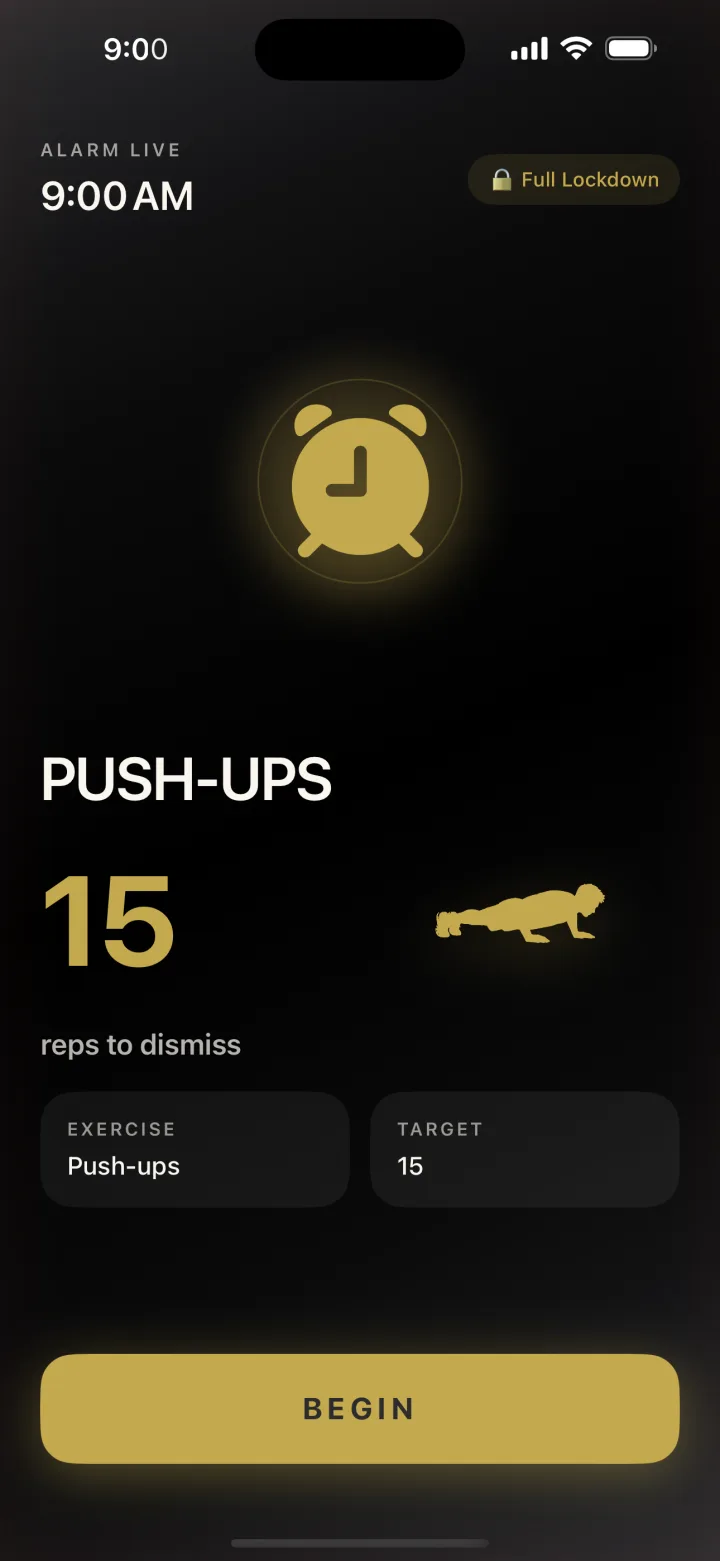
RiseReps only goes quiet when your iPhone's camera counts your reps. No snooze, no tap-to-dismiss, and Persistent mode re-fires if you bail. Nothing recorded or uploaded.
How to get out of bed in the morning when tired
If you're dragging every single morning, tricks only go so far. Being tired at 6:30 a.m. is usually a sleep problem showing up at the worst possible time.
Check the math on your sleep
The CDC recommends 7 or more hours a night for adults aged 18 to 60. Count back from your alarm. If you need to be up at 6:30 and you fall asleep at 12:45, no alarm in the world will make that feel good. Moving your bedtime 20 or 30 minutes earlier is less exciting than a new morning hack, and it works better.
Keep the same wake time every day
The CDC's healthy sleep habits list starts with going to bed and getting up at the same time every day, weekends included. A Saturday lie-in until 10 pushes your clock later, so Monday's alarm lands at what your body treats as 4 a.m. That's why Monday mornings feel uniquely terrible. If you want a step-by-step plan for shifting your clock, see how to wake up early.
Go easy on late caffeine and alcohol
The CDC also suggests avoiding caffeine in the afternoon or evening, and large meals and alcohol before bed. A 4 p.m. coffee or a couple of drinks won't wreck you once. Every day, they make it harder to fall asleep early enough for the morning to feel fine.
How to get out of bed when you don't want to
Sometimes you're not exhausted. You just don't want to. The day ahead feels like a chore, the bed feels like the only good thing going, and getting up means starting all of it. That's a motivation problem, and it has different fixes.
Make the first step tiny
"Get up, work out, shower, answer emails" is a mountain. "Sit up" is a pebble. Shrink the first thing you ask of yourself until it's almost silly, then let momentum do the rest. Once you're standing, the next step is much easier than the first.
Give yourself something to get up for
A good coffee. Ten quiet minutes before anyone else is up. A podcast you only listen to in the morning. It doesn't need to be meaningful. It needs to be better than lying there.
Let someone else know
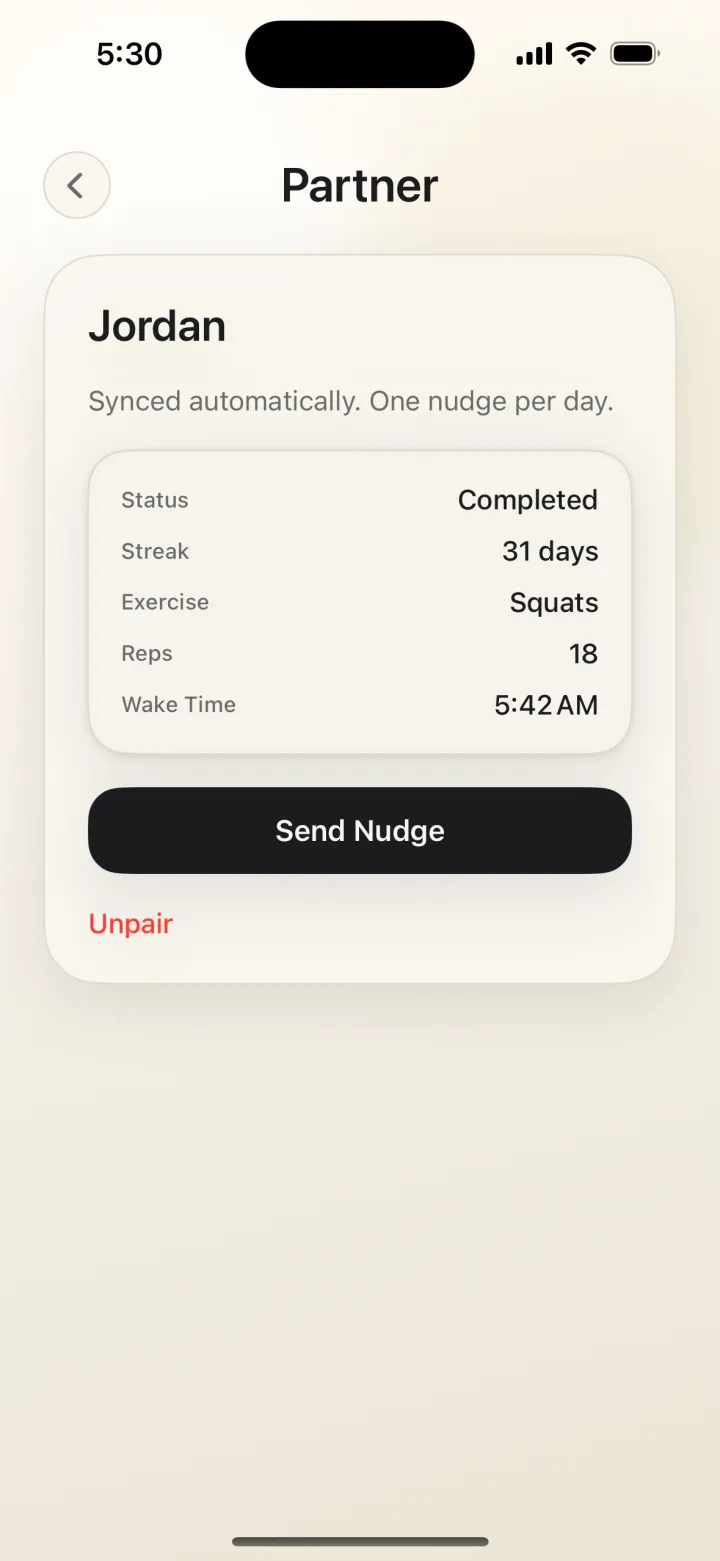
It's easy to let yourself down quietly. It's harder when someone can see it. A friend who's also trying to get up earlier works well here, especially if neither of you wants to be the one who broke the streak.
How to get out of bed in the morning when it's cold
Cold mornings are their own special kind of hard. The CDC suggests keeping your bedroom at a cool temperature for sleep, so the goal isn't a hot bedroom. It's making the first five minutes less brutal. Leave a hoodie and socks right next to the bed. Put a heater on a timer so the bathroom or kitchen is warm when you get there. Make that first warm drink something you can start the night before.
How to get up in the morning right away: make the alarm do the work
Everything above helps. But if you're honest, the moment that breaks most mornings is the same one: alarm rings, thumb taps, eyes close. Half-asleep you is very good at tapping Stop. It's also weirdly good at the math puzzles some alarm apps use. What it's bad at is anything that needs you standing up and moving.
That's the idea behind RiseReps. When the alarm fires, your iPhone's camera counts a set of push-ups, squats or jumping jacks, and the alarm only goes quiet when your reps are done. There's no snooze button and no tap-to-dismiss. Persistent mode re-fires the alarm every 60 seconds if you close the app, and optional Full Lockdown blocks your other apps until you finish, which takes care of the phone-in-bed problem too. Counting uses on-device pose detection, so nothing is recorded or uploaded.
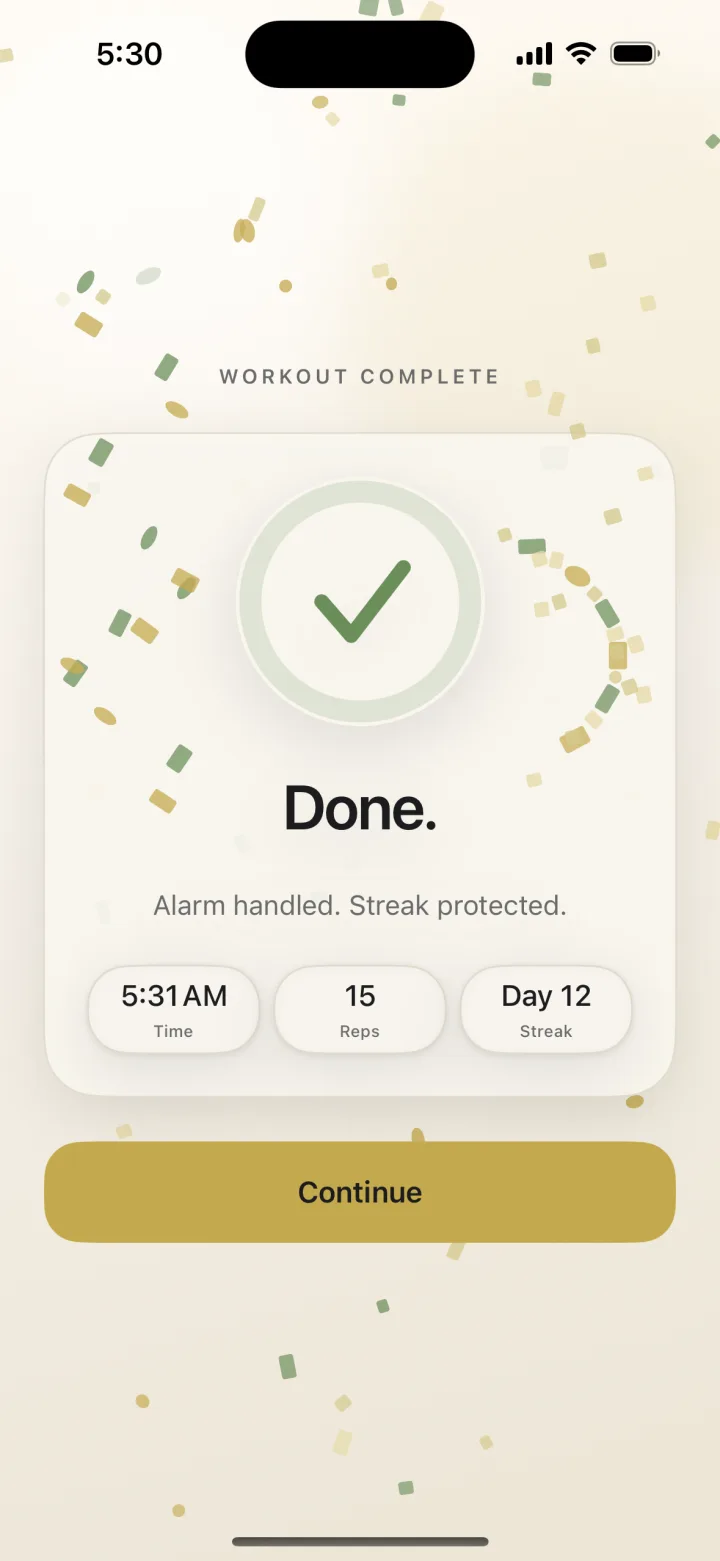
It lines up with the fixes in this guide. You're on your feet within the first minute, you get a short burst of movement while the fog is worst, and there's no decision to lose. You pick the time, exercise and rep count the night before, so morning-you just follows the plan. Weekly progression can raise your reps over time, and your streak and wake times are logged automatically. It's free to download on the App Store. For a closer look at setup and how many reps to start with, see the alarm that makes you do push-ups.
Can't get out of bed in the morning? When it's more than tiredness
Everyone has rough mornings. But if you can't get out of bed most days, no matter how much you sleep or what you try, it's worth looking a bit further. Two things come up a lot in searches, and both deserve a real answer rather than a pep talk.
How to get out of bed in the morning with ADHD
Many people with ADHD find mornings especially hard, and there's research behind that. A 2017 systematic review in ADHD Attention Deficit and Hyperactivity Disorders by Coogan and McGowan looked at 62 studies and found consistent evidence linking ADHD with a later chronotype and delayed sleep timing. In plain words, the body clock often runs late, so early alarms land in the biological middle of the night.
That makes the body-clock fixes above (steady wake time, morning light, dimmer evenings) extra important, and our guide on how to be a morning person lays them out as a 3-week plan. Outside structure helps too: alarms you can't dismiss from bed, a partner who checks in, and as few morning decisions as possible. If mornings are a constant fight, a doctor who knows ADHD can help with sleep timing as part of your treatment.
When it might be depression
Sometimes not being able to get out of bed isn't about sleep or motivation. The National Institute of Mental Health lists fatigue or lack of energy, and sleep changes like waking too early or oversleeping, among the signs of depression, especially when symptoms last most of the day, nearly every day, for at least two weeks.
An alarm app, this guide included, can't diagnose that or fix it. If that sounds like you, talk to a doctor or mental health professional. If you're struggling or having thoughts of suicide, you can call or text 988 to reach the Suicide & Crisis Lifeline in the US.
Other reasons to see a doctor
- You get 7+ hours on a steady schedule and still feel wrecked most mornings.
- You often fall asleep during the day, at your desk or while driving.
- Someone tells you that you snore loudly or stop breathing in your sleep.
- You sleep through alarms that wake everyone else in the house.
If the last one sounds familiar, our guide on why you sleep through your alarms covers the common causes.
FAQ
Why is it so hard to get out of bed in the morning?
Right after waking, your brain is still groggy (sleep inertia), and the parts that handle planning and decisions come back online last. That grogginess is worse after short sleep or waking at a bad time for your body clock. Add a warm bed and an easy-to-dismiss alarm, and staying put wins by default.
Should I get out of bed as soon as I wake up?
For most people who struggle with mornings, yes. Lingering often turns into falling back asleep. A 2024 study found a short snooze period didn't hurt habitual snoozers, but if snoozing regularly makes you late, getting up on the first alarm is the simpler rule.
How do I get out of bed in the morning when I'm tired?
In the moment: sit up and put your feet on the floor right away, get light, and move for 30 seconds. Long term: aim for 7 or more hours of sleep and keep the same wake time every day, weekends included. If you're tired every morning despite that, talk to a doctor.
How do you get out of bed when you don't want to?
Make the first step tiny, like just sitting up. Decide the night before so there's nothing to debate, give yourself something to look forward to, and use outside help such as an alarm you can't switch off from bed or a friend who checks in.
Why can't I get out of bed in the morning?
The most common reasons are too little sleep, a body clock that runs later than your alarm, and an alarm that's too easy to turn off. ADHD is linked to later sleep timing, and depression can cause fatigue and oversleeping. If you can't get up most days whatever you try, see a doctor.
Sources
- Wertz A. T., Ronda J. M., Czeisler C. A., Wright K. P. (2006). Effects of sleep inertia on cognition. JAMA, 295(2), 163–164. University of Colorado summary.
- Hilditch C. J., McHill A. W. (2019). Sleep inertia: current insights. Nature and Science of Sleep, 11, 155–165. Abstract.
- Kovac K., Vincent G. E., Paterson J. L., Reynolds A., Aisbett B., Hilditch C. J., Ferguson S. A. (2021). The impact of a short burst of exercise on sleep inertia. Physiology & Behavior, 242. Abstract.
- Wright K. P., McHill A. W., Birks B. R., Griffin B. R., Rusterholz T., Chinoy E. D. (2013). Entrainment of the human circadian clock to the natural light-dark cycle. Current Biology, 23. Abstract.
- Sundelin T., Landry S., Axelsson J. (2024). Is snoozing losing? Why intermittent morning alarms are used and how they affect sleep, cognition, cortisol, and mood. Journal of Sleep Research. Abstract.
- Coogan A. N., McGowan N. M. (2017). A systematic review of circadian function, chronotype and chronotherapy in attention deficit hyperactivity disorder. ADHD Attention Deficit and Hyperactivity Disorders, 9(3), 129–147. Abstract.
- Centers for Disease Control and Prevention. About Sleep.
- National Institute of Mental Health. Depression.