Doing push ups every day is one of the simplest fitness habits there is. No gym, no gear, no commute, about a minute of your time. That's exactly why so many people try it, and why so many people quit by week two with sore wrists or a plan that got too ambitious too fast.
So here's the honest version. Yes, daily push-ups are fine for most healthy people, and they can build real strength. But how many you do, how hard you push each set, and when you do them matter a lot more than the "every day" part. Below is what the research actually supports, what it doesn't, and a plan that starts small enough to survive a bad Tuesday.
Is it OK to do push ups every day? For most healthy adults, yes, as long as you stop each set a few reps short of failure and nothing hurts. Start with about half your max per day (split into sets if you like) and add a few reps each week. Push-ups can build chest and triceps muscle about as well as a comparable bench press, but only if you keep making them harder. For muscle growth, your total weekly reps matter more than training every day, so daily push-ups are mainly a great way to make the habit stick.
Is it OK to do push ups every day?
Mostly, yes. The thing that decides whether daily push-ups help or hurt isn't the frequency. It's how close to your limit you go each time.
A set that stops while you still have two or three good reps left is easy to recover from. You can do that daily for months. A set where you grind out the last ugly rep with your hips sagging is a different animal. Do that every single day and your shoulders, elbows and wrists never get a quiet day.
Official guidelines don't ask for daily strength work either. The CDC's adult activity guidelines recommend muscle-strengthening activity on 2 or more days a week that works all major muscle groups, including chest, shoulders and arms. Push-ups count for those. Doing them more often than twice a week is allowed, not required.
When push ups every day is a bad idea
- Something hurts. Sharp or lingering pain in your wrists, elbows, shoulders or lower back is a stop sign, not a toughness test. Take days off and fix your form or switch to an easier variation.
- You go to failure every time. Save max-effort sets for a once-a-week test, if at all.
- Push-ups are your only exercise. They don't train your legs, your back's pulling muscles or your heart and lungs much. They're one good habit, not a full program.
- You have a heart condition, high blood pressure or an injury. Ask your doctor before starting anything new. That's not boilerplate; straining hard against your own bodyweight does put load on your heart and joints.
What happens if you do push ups every day
There's no study that tracked "people who did push-ups every day for a month," so be wary of anyone promising specific before-and-after numbers. What we do have is a decent body of training research. Here's a realistic picture for a beginner doing moderate daily sets.
Week 1: it feels harder than it should
Your chest, triceps and front of your shoulders will probably be sore for the first few days, especially if you haven't done push-ups in a while. That fades quickly. You'll also notice the reps getting smoother before you've built any visible muscle. Early on, a lot of the progress is simply your body getting better at the movement.
Push ups every day for a month
By week four, most people can do noticeably more reps than they started with, and the daily set stops feeling like an event. In a 2015 study in the Journal of Strength and Conditioning Research, Calatayud and colleagues had trained university students do either heavy bench press or push-ups made harder with an elastic band for 5 weeks. Both groups got significantly stronger, with similar gains. The control group didn't change.
That's a meaningful result: push-ups aren't a "lite" exercise if you load them enough. It's also why the band mattered. Standard push-ups get easy, and easy reps stop driving progress.
After 2 to 3 months
This is where daily push-ups either keep working or quietly plateau. If you're still doing the same 20 reps you could do in week three, your body has no reason to change. People who keep progressing add reps, slow the lowering phase down, or move to harder variations like decline or deficit push-ups.
Will doing push ups every day build muscle?
Yes, it can. "Will doing push ups everyday build muscle" is one of the fastest-rising push-up searches right now, and the research answer is more encouraging than you might expect.
In a 2017 study in the Journal of Exercise Science & Fitness, Kikuchi and Nakazato randomly assigned 18 young men to either a light bench press (40% of their one-rep max) or push-ups adjusted to the same load, twice a week for 8 weeks. Both groups gained bench press strength and grew their triceps and pectoralis major (chest) muscle thickness. The authors concluded push-ups at that load were comparably effective to bench press for muscle growth and strength.
Two caveats keep this honest. Those were small studies in young men, and both made sure the push-ups were hard enough. Doing 15 easy reps a day forever will keep you fit, but it won't keep building muscle. To grow, the work has to keep getting harder:
- More reps per set, until you can do around 20 to 30 clean ones.
- Slower reps. Take three seconds to lower yourself.
- Harder variations: feet elevated, hands closer together, or pausing at the bottom.
- More total sets across the week.
Push ups every day or every other day?
This is the question that splits the internet, so here's what three different studies say.
Training a muscle twice a week beats once a week. A 2016 meta-analysis in Sports Medicine by Schoenfeld, Ogborn and Krieger pooled ten studies and found higher training frequency was linked with more muscle growth, with twice a week coming out ahead of once a week. Whether three times beats two was still unclear.
Past that, total volume matters more than frequency. In a 2019 study in the Journal of Strength and Conditioning Research, Saric and colleagues had trained men do the same total amount of work spread over either 3 or 6 sessions a week for 6 weeks. Both groups gained similar strength and muscle size. Splitting it into six days didn't add anything, and it didn't hurt either.
Small daily doses can punch above their weight. A 2022 study in the Scandinavian Journal of Medicine & Science in Sports by Yoshida, Sato and colleagues compared three groups doing maximal arm contractions for 4 weeks. Six contractions once a week did nothing measurable. Six contractions a day, five days a week, increased strength by roughly 9 to 14%. Thirty contractions crammed into one day a week grew the muscle about as much, but only the daily group got significantly stronger. It was a lab study on the biceps, not push-ups, but it points the same way: a little, often, adds up.
So the honest answer to "push ups every day or every other day": for results, either works if your weekly total is the same. Every day has one big advantage, though. A daily habit is easier to keep than a schedule. You don't have to remember whether today is push-up day. It just is.
If you go daily, keep most days moderate and treat one or two days a week as lighter or off when your joints ask for it.
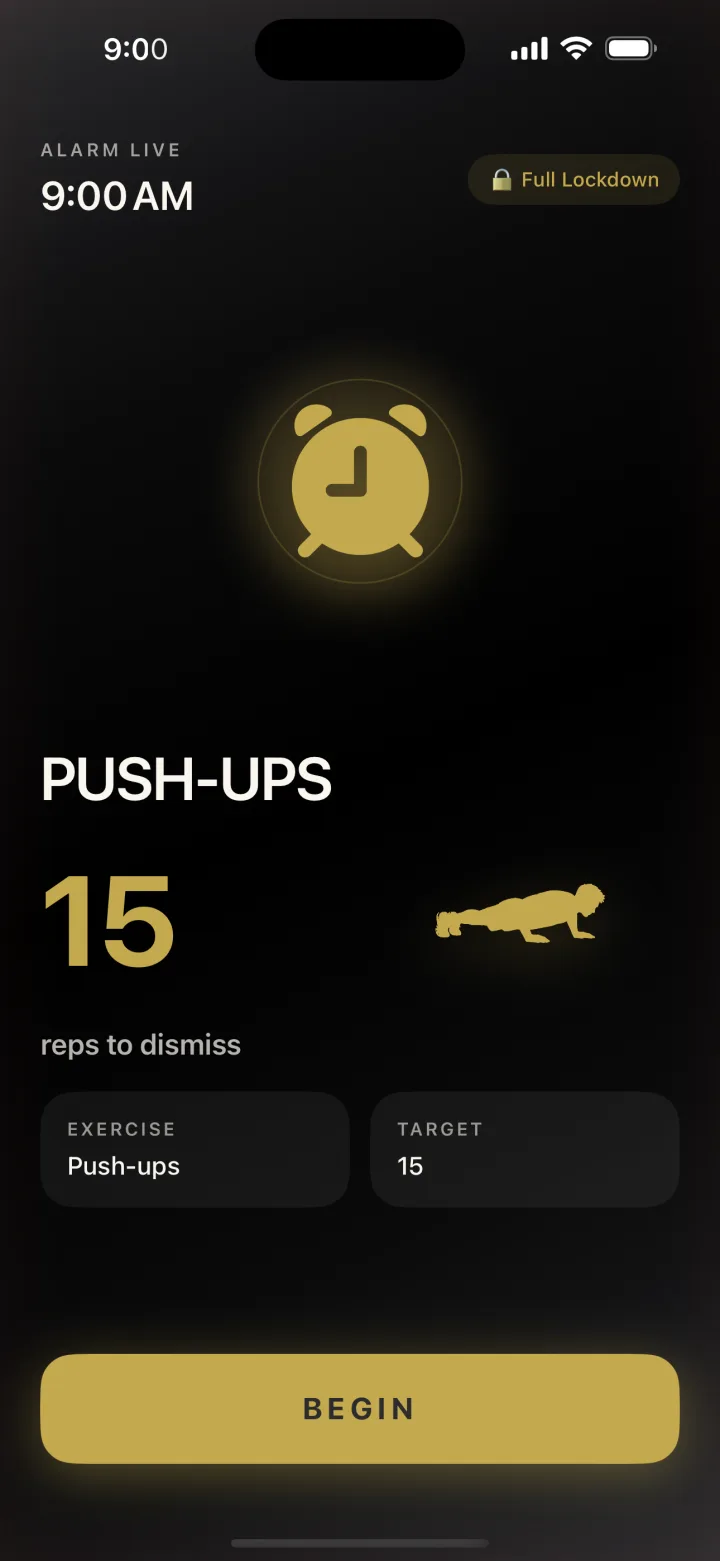
RiseReps only goes quiet when your iPhone's camera counts your push-ups, squats or jumping jacks. No snooze, no tap-to-dismiss, and built-in progression can raise your reps each week. Counting happens on your device, nothing uploaded.
How many push ups a day should I do?
Start by finding your number. On a fresh afternoon, do as many good push-ups as you can in one go: body straight, chest close to the floor, arms fully extended at the top. Stop when your form breaks, not when you collapse. That's your max.
Then do about half of that each day. Split it into two or three sets if you want more total reps without grinding. Add two to five reps a week. These are starting points, not science, so adjust after a week.
| Your max (fresh) | Daily starting point | Notes |
|---|---|---|
| 0 to 3 | 2 sets of 8 wall or incline push-ups | Hands on a counter, then a chair, then the floor |
| 4 to 10 | 2 sets of 3 to 5 | Knee push-ups for extra reps are fine |
| 11 to 25 | 2 to 3 sets of 6 to 12 | The sweet spot for daily practice |
| 26 to 40 | 3 sets of 12 to 20 | Start slowing the lowering phase |
| 40+ | 3 sets of 20, or harder variations | Reps alone get long; add difficulty instead |
Is 10, 20 or 50 push ups a day enough?
Enough for what? Ten a day won't transform your physique, but if you're doing zero now, it builds the habit and a base of strength, and it's 70 reps a week you weren't doing. Twenty to thirty a day is a solid maintenance dose for most people and enough to keep progressing as a beginner. Fifty or more is plenty of volume for your chest and triceps, as long as it isn't all in one grinding set. Chasing the classic target? Our guide to 100 push ups a day shows how to split the sets and build up to it.
Push ups throughout the day vs all at once
Spreading sets across the day (some people call it "greasing the groove") lets you do more total reps with less fatigue per set. There's little direct research on push-ups specifically, but it fits the frequency studies above: weekly volume is what counts, and fresh reps are cleaner reps. The downside is that "a few sets whenever" is easy to forget. Tying at least one set to a fixed moment of the day solves that.
A 4-week push ups every day plan
This assumes a max of around 10 to 20. Scale the numbers up or down using the table above. Do it at the same time every day; the morning works best for the reasons in the next section.
| Week | Daily sets | Focus |
|---|---|---|
| 1 | 2 × half your max | Form. Straight body, full range, no rushing. |
| 2 | 2 × (half your max + 2) | Same time every day. Don't skip, go lighter instead. |
| 3 | 3 × (half your max + 2) | Add a third set. Lower slowly on the last one. |
| 4 | 3 × (half your max + 4) | Retest your max at the end of the week. |
Two rules make this work. First, a bad day means fewer reps, not zero reps. Five push-ups keep the streak alive; skipping trains you to skip. Second, retest every four weeks and reset your numbers from the new max.
Form in 30 seconds
- Hands a bit wider than your shoulders, fingers spread, wrists under your shoulders.
- Squeeze your glutes and brace your stomach so your body moves as one plank.
- Elbows at roughly 45 degrees from your body, not flared straight out.
- Lower until your chest is a fist's height from the floor, then press all the way up.
- Wrists complain? Try push-up handles or do them on your fists on a soft surface.
Why push ups every morning work best
"Push ups in the morning or at night?" comes up a lot. For strength, the time of day matters far less than doing them consistently. For the habit, mornings have a real edge: nothing has gone wrong yet, nobody's emailed you, and there's no "I'll do them later" that turns into midnight.
The morning has one obvious problem, though. You're groggy, warm, horizontal and very good at negotiating. That's the moment most daily push-up plans die. Our guides on how to get out of bed in the morning and how to wake up early cover the wake-up side in depth. The short version: decide the night before, and make the first action after the alarm a physical one.
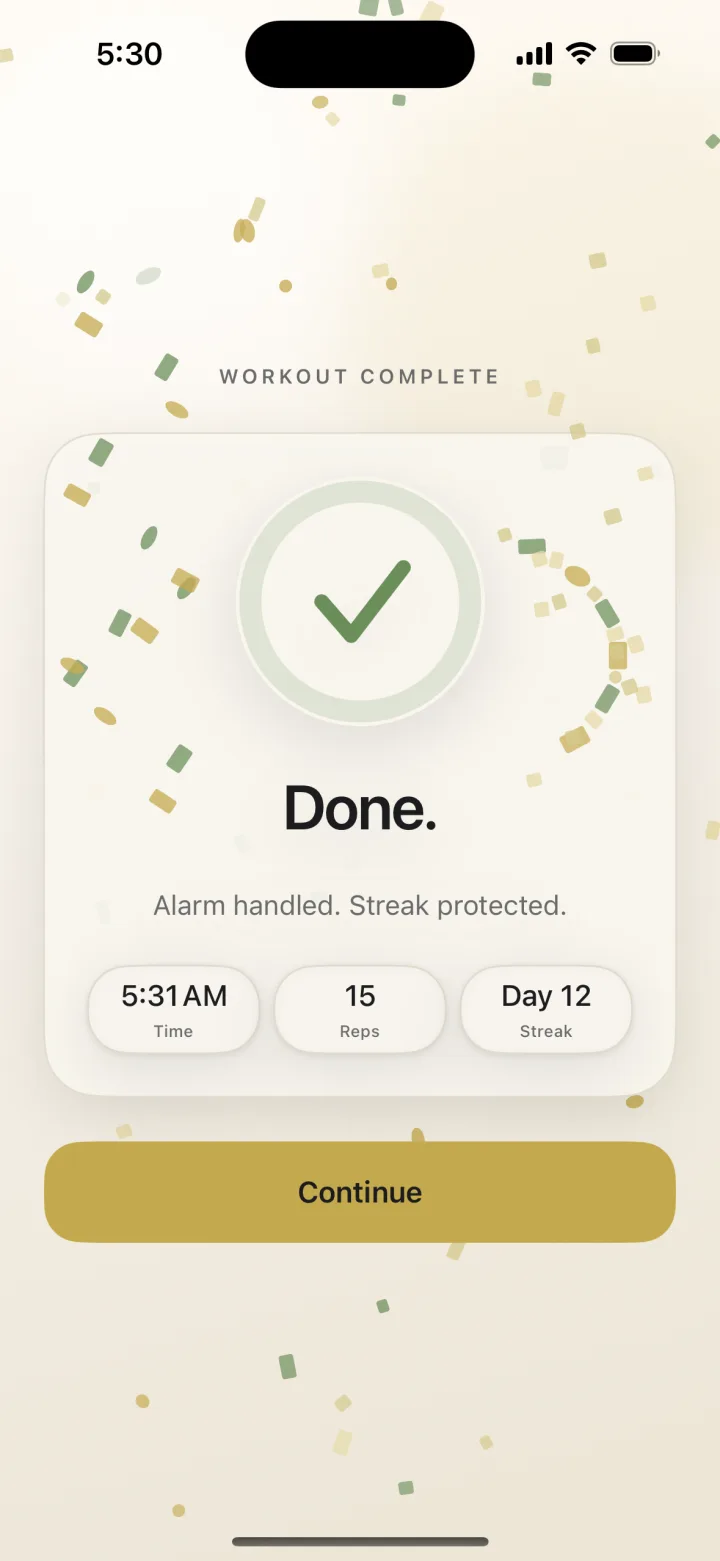
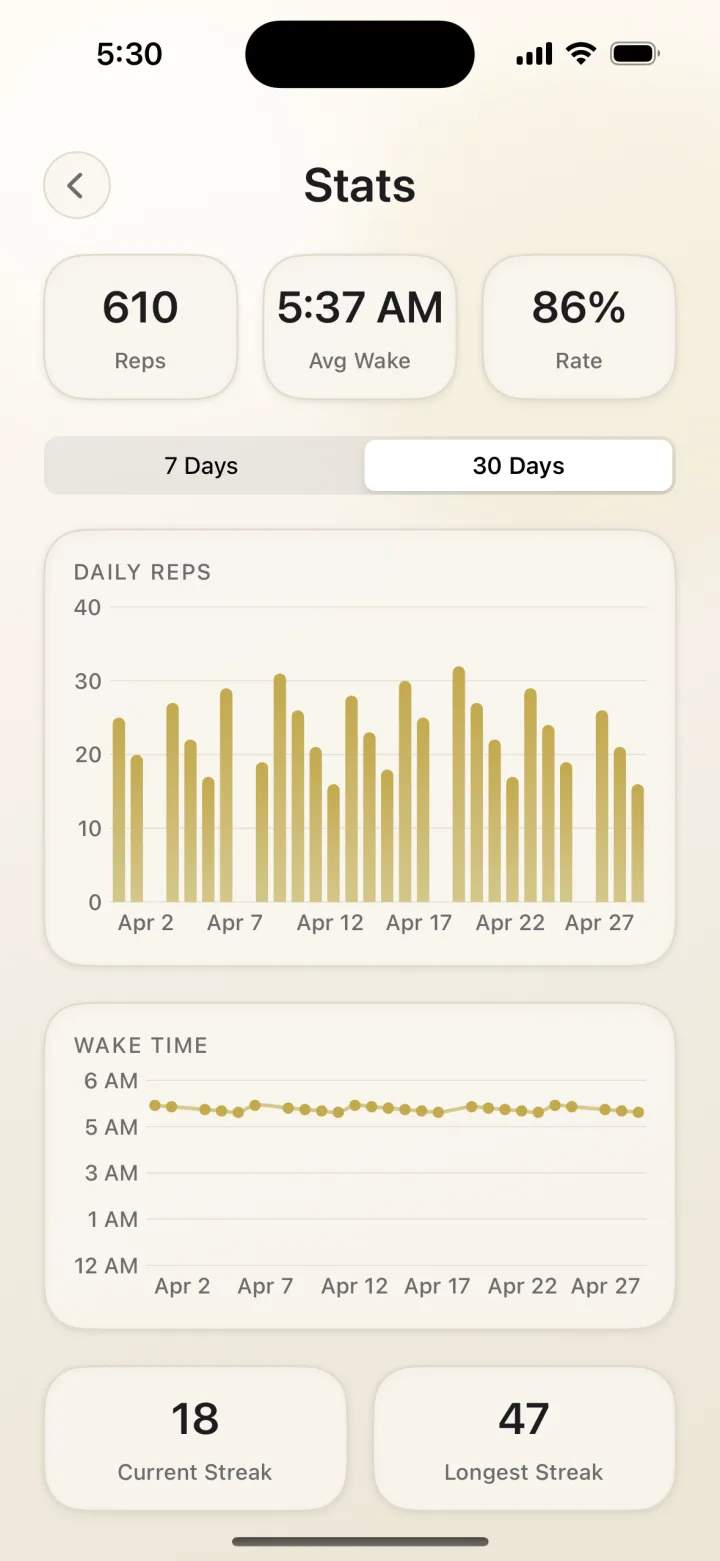
That's literally how RiseReps works. When your alarm fires, your iPhone's camera counts a set of push-ups, squats or jumping jacks using on-device pose detection, and the alarm only stops when your reps are done. No snooze button, no tap-to-dismiss, and Persistent mode re-fires the alarm every 60 seconds if you close the app. You pick the rep count, built-in progression can raise it each week (the plan above, on autopilot), and your streak and stats log themselves. Nothing is recorded or uploaded. If you want push ups every day without relying on willpower at 6 a.m., RiseReps is free to download on the App Store. Our post on the alarm that makes you do push-ups covers setup, phone placement and lighting.
Warm up for 20 seconds before your first set: a few arm circles and two or three easy reps on your knees. You're stiffer straight out of bed, and a cold first rep is when wrists and shoulders tend to complain.
The long-term payoff
Push-up ability is worth building beyond how your shirt fits. A 2019 study in JAMA Network Open by Yang and colleagues followed 1,104 active male firefighters for 10 years. Men who could do more than 40 push-ups at baseline had a much lower risk of cardiovascular events than men who managed fewer than 10. It's an association in one group of men, and the authors called push-up capacity a simple measure of fitness, not a treatment. But it's a nice reason to keep your number climbing.
FAQ
Is it OK to do push ups every day?
For most healthy adults, yes, as long as each set stops a few reps short of failure and nothing hurts. Going to failure every day or pushing through wrist, elbow or shoulder pain is where it goes wrong. If you have a heart condition, high blood pressure or an injury, check with a doctor first.
Will doing push ups every day build muscle?
It can. Studies have found that push-ups loaded to a similar level as a bench press build chest and triceps muscle and strength about as well. The catch is progression: once your sets feel easy, add reps, slow down or switch to a harder variation, or the gains stall.
How many push ups a day should I do?
Test how many good push-ups you can do in one go, then do about half of that each day, split into two or three sets if you like. Add two to five reps a week. If you can't do a full push-up yet, start with wall or incline push-ups.
Is it better to do push ups every day or every other day?
For strength and muscle, your total weekly work matters more than how you split it. A 2019 study found training 3 or 6 days a week gave similar results when total volume was the same. Daily push-ups win on habit, because a small set every day is easier to stick to than a schedule.
Is it good to do push ups every morning?
Yes, if it gets you doing them consistently. Mornings work well because nothing has derailed your day yet. Warm up with arm circles and a few easy reps first, since you're stiffer straight out of bed.
Sources
- Calatayud J., Borreani S., Colado J. C., Martin F., Tella V., Andersen L. L. (2015). Bench press and push-up at comparable levels of muscle activity results in similar strength gains. Journal of Strength and Conditioning Research, 29. Abstract.
- Kikuchi N., Nakazato K. (2017). Low-load bench press and push-up induce similar muscle hypertrophy and strength gain. Journal of Exercise Science & Fitness, 15. Full text.
- Schoenfeld B. J., Ogborn D., Krieger J. W. (2016). Effects of resistance training frequency on measures of muscle hypertrophy: a systematic review and meta-analysis. Sports Medicine, 46. Abstract.
- Saric J., Lisica D., Orlic I., Grgic J., Krieger J. W., Vuk S., Schoenfeld B. J. (2019). Resistance training frequencies of 3 and 6 times per week produce similar muscular adaptations in resistance-trained men. Journal of Strength and Conditioning Research, 33. Abstract.
- Yoshida R., Sato S., Kasahara K., Murakami Y., Murakoshi F., Aizawa K., Koizumi R., Nosaka K., Nakamura M. (2022). Greater effects by performing a small number of eccentric contractions daily than a larger number of them once a week. Scandinavian Journal of Medicine & Science in Sports, 32. Abstract.
- Yang J., Christophi C. A., Farioli A., Baur D. M., Moffatt S., Zollinger T. W., Kales S. N. (2019). Association between push-up exercise capacity and future cardiovascular events among active adult men. JAMA Network Open, 2. Full text.
- Centers for Disease Control and Prevention. Adult Activity: An Overview.