The day belonged to everyone else. Your boss, your inbox, your commute, maybe your kids. Then 10 p.m. hits, the house goes quiet, and finally there's time that's just yours. So you keep it. One more episode, one more scroll, one more round. You know you'll pay for it at 6:30. You do it anyway.
That's revenge bedtime procrastination: staying up later than you meant to, not because you can't sleep, but because going to bed feels like handing over the last bit of the day you control. It's common, it's understandable, and it's very fixable. The trick is that the fix isn't "have more willpower at midnight." It's changing what happens before 10 p.m. and after your alarm goes off.
Revenge bedtime procrastination is choosing to stay up late to win back free time you didn't get during the day, even though you're tired and nothing is stopping you from going to bed. To stop it: build real me-time into your evening so it has an end, set a "start winding down" alarm 30 to 60 minutes before bed, swap the phone for something with a natural stopping point, and charge your phone outside the bedroom. Then anchor a fixed wake time and use your mornings as me-time too. Research links bedtime procrastination with shorter sleep, worse sleep quality and more daytime fatigue.
What is revenge bedtime procrastination?
Researchers were studying the behaviour before the internet gave it the "revenge" label. In 2014, a team at Utrecht University led by Floor Kroese introduced the term bedtime procrastination in Frontiers in Psychology. Their definition is useful because it's so specific: failing to go to bed at the time you intended, while no external circumstances stop you from doing so.
Three things have to be true:
- You go to bed later than you planned.
- Nothing forces you to. A crying baby, a night shift or a deadline doesn't count.
- You know it's a bad trade. You'd sleep more if you went to bed, and part of you wants to.
In that first survey of 177 people, those who reported more bedtime procrastination also reported getting insufficient sleep, even after accounting for demographics and general self-control.
Where the "revenge" part comes from
The Sleep Foundation explains that the English phrase came from a translation of a Chinese expression about long, stressful work hours that left little time for personal enjoyment. Staying up late becomes a way of getting "revenge" on a day that had no free time in it. The idea spread worldwide on social media and picked up more traction during the stress of the COVID-19 pandemic. It's also why Google's rising searches right now include "revenge bedtime procrastination chinese" and "revenge bedtime procrastination meaning."
The irony is obvious once you say it out loud: the person you're getting revenge on is tomorrow's you.
Revenge bedtime procrastination vs insomnia
These get mixed up a lot, and the difference matters because the fixes are different. With bedtime procrastination, you could fall asleep, you just don't go to bed. With insomnia, you go to bed and can't fall or stay asleep.
There's a grey zone. In a 2019 interview study in Behavioral Sleep Medicine, Nauts and colleagues talked in depth with 17 frequent bedtime procrastinators. Some stayed up because they felt they needed to be very tired to fall asleep quickly. The researchers called that strategic delay and noted it may actually be linked to undiagnosed insomnia. If that sounds like you, a doctor is a better next step than a productivity trick.
Do I have revenge bedtime procrastination?
There's no official test, and it isn't a diagnosis. But if most of these ring true, you're in the club:
- You often go to bed later than you'd planned, on purpose or by "losing track."
- You're sleepy, but going to bed feels like the day is ending too soon.
- It's worse after busy or stressful days.
- The late hours are spent on your phone, TV or games rather than anything you'd call important.
- You regret it at the alarm, and do it again that night.
Why do I revenge bedtime procrastinate?
The honest answer: the research is young, and most of it shows links rather than proven causes. But a few patterns keep showing up.
"I deserve some time for myself"
The Nauts study found three flavours of late bedtimes. The first, deliberate procrastination, is the classic revenge version: people knowingly pushed their bedtime back because they felt they deserved some time for themselves. A 2024 interview study of 28 new career starters in the British Journal of Health Psychology by Hill and colleagues heard the same thing, and one participant's description became the paper's title: "It's satisfying but destructive." Participants stressed the need for me-time and described negotiating with themselves to keep going.
You lose track of time
The second flavour is mindless procrastination: getting so absorbed in the evening's activity that bedtime slides past without a real decision. In the career-starter study, one theme was simply "technology captures late-night attention." Feeds and autoplay are built to have no natural ending, so you're relying on a tired brain to supply one.
Hard days make it worse
If your worst nights follow your worst days, you're not imagining it. In a 2018 study in Frontiers in Psychology, Kamphorst and colleagues asked 218 people how many desires they'd tried to resist during the day. Those who'd resisted more were more likely to procrastinate on bedtime that night. The day used up their self-control, and bedtime was where it ran out.
A night-owl body clock
The biggest summary so far is a 2022 systematic review and meta-analysis in Sleep Medicine Reviews by Hill, Rebar, Ferguson, Shriane and Vincent, which pooled 43 studies. Bedtime procrastination had a moderate link with lower self-control and a moderate link with an evening chronotype, meaning people whose body clock naturally runs late. If you're not sleepy at 11 because your clock thinks it's 9, of course you stay up. The authors rated the evidence quality as low and called for better studies, so treat this as a strong pattern, not a verdict. Our guide on how to be a morning person covers how to shift a late clock earlier.
The effects of revenge bedtime procrastination: what it does to your mornings
The same meta-analysis found bedtime procrastination was moderately linked with shorter sleep, worse sleep quality and more daytime fatigue. None of that is surprising. The CDC recommends 7 or more hours of sleep for adults 18 to 60, and every hour of "me time" after midnight comes straight out of that.
What most articles skip is the morning half of the loop, because that's where it keeps itself going:
- You stay up to get time back.
- The alarm hits a short night. You wake in the middle of deep grogginess (that's sleep inertia), and a groggy brain is great at hitting snooze.
- You snooze, then rush. Any morning time you might have had for yourself is gone.
- The day feels even less like yours, so that night the "revenge" feels even more deserved.
That's why fixing only the night side often fails. If you never get any time back in the morning, the evening keeps feeling like the only option. Breaking the loop at both ends works better.
How to stop revenge bedtime procrastination: 9 fixes
Pick two or three to start. You don't need all nine, and trying to overhaul everything in one week is how plans like this die.
1. Pick a real bedtime, then set an alarm for the wind-down
Count back from your wake time. If you need to be up at 6:30 and want 7.5 hours, lights out is 11:00. Now set a second alarm for 10:15 that means "start getting ready for bed," not "be asleep." The hard part isn't falling asleep. It's starting. A reminder gives the evening an ending you didn't have to invent while tired.
2. Schedule the me-time so it has an end
If the craving is for time that's yours, give yourself some on purpose. Block 45 minutes in the evening, say 9:00 to 9:45, that's genuinely protected: no chores, no work messages, guilt-free. When it's planned and bounded, it's much easier to let the rest of the night go. When it's stolen at 1 a.m., it never feels like enough.
3. Swap the phone for something with a stopping point
An episode ends. A chapter ends. A feed doesn't. Researchers are testing this directly. In a 2025 pilot trial in Sleep Medicine, Hill and colleagues ran an online program for 55 new career starters to cut evening screen time, partly by substituting other activities. On average, participants used their devices about 23 minutes less per night before sleep and slept about 13 minutes longer per night after the program, and bedtime procrastination kept falling at follow-up. It was a small pilot and every group improved, including the control group, so it's an early signal rather than proof. But it points the right way: replace the phone, don't just white-knuckle it.
4. Charge your phone outside the bedroom
There's a second kind of sleep procrastination that happens after you're already in bed. In a 2020 study of 400 high school students in the International Journal of Environmental Research and Public Health, Magalhães and colleagues described while-in-bed procrastination and found it was only weakly related to bedtime procrastination. In other words, getting into bed on time doesn't help much if the phone comes with you. A cheap charger in the kitchen solves more than most apps. If your phone is your alarm, a separate alarm clock (or putting the phone across the room) works too.
5. Plan easier evenings after hard days
Given the Kamphorst finding, don't count on willpower after a draining day. Decide ahead of time: "On days I get home after 8, I go straight to my wind-down and skip the TV." An if-then plan made at noon is a lot more reliable than a decision made at midnight.
6. Fix your wake time first
It sounds backwards, but a consistent wake time is the strongest lever on your bedtime. Get up at the same time every day, weekends included, and you'll be genuinely sleepy earlier within a week or two. Sleeping in until 11 on Saturday just sets up a later Sunday night. Our guide on how to wake up early walks through the full plan.
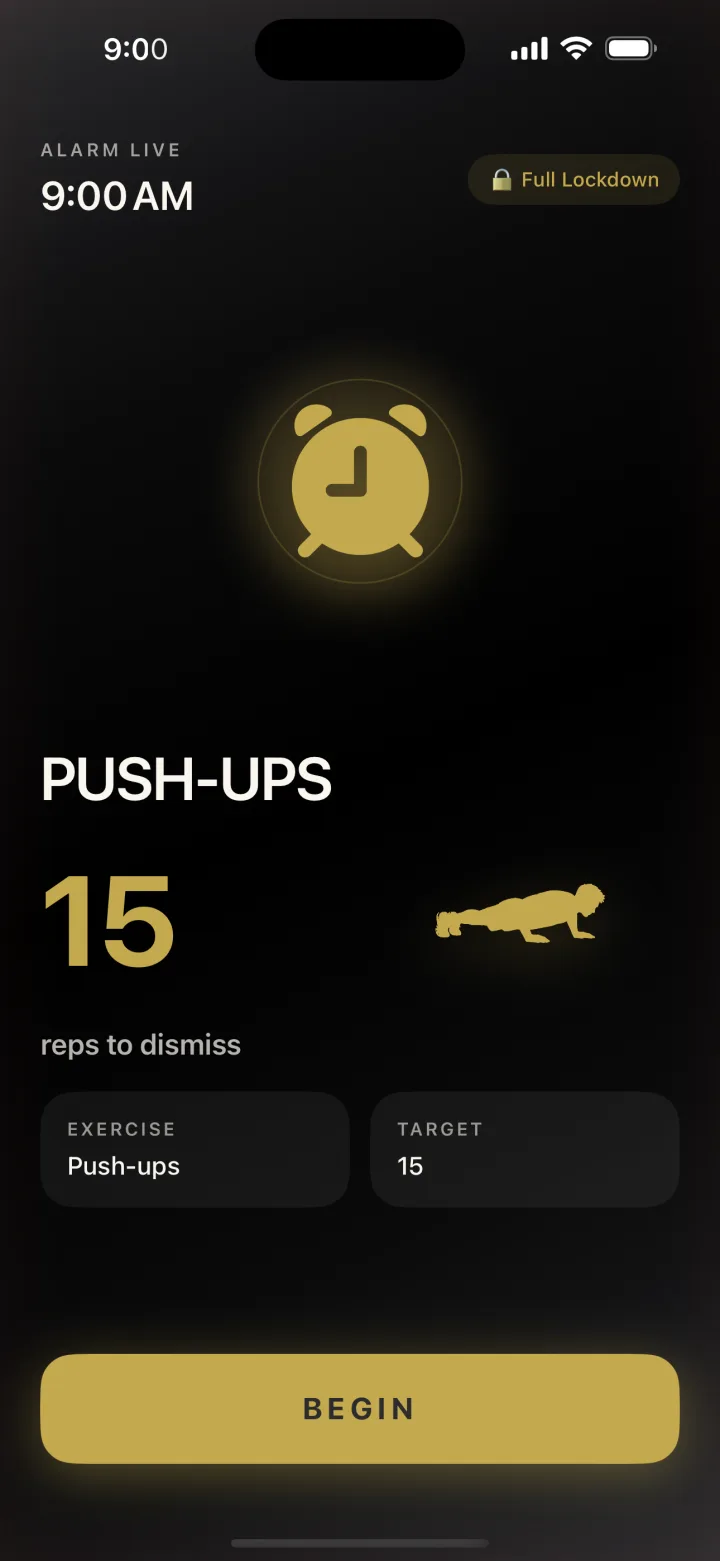
RiseReps only goes quiet when your iPhone's camera counts your push-ups, squats or jumping jacks. No snooze, no tap-to-dismiss, and Persistent mode re-fires every 60 seconds if you bail. Counting happens on your device, nothing uploaded.
7. Move the me-time to the morning
This is the one that breaks the loop. The night feels like the only time that's yours because, right now, it is. Mornings are a rushed blur after a snooze or three. But a quiet 30 minutes before anyone needs you is the same free time, without the sleep debt attached. Coffee that's still hot, a book, a walk, a workout, nothing at all. Once your mornings have something in them you actually want, giving up the 1 a.m. scroll stops feeling like a loss.
The catch: that only works if you actually get up. Which brings us to the alarm.
8. Make the alarm impossible to beat half-asleep
If your alarm can be silenced with one tap from under the duvet, the groggy version of you will do it every time, especially on a short night. Turn snooze off, put the alarm across the room, or use an alarm that only stops once you're up and moving. Our guide on how to stop hitting snooze covers every option.
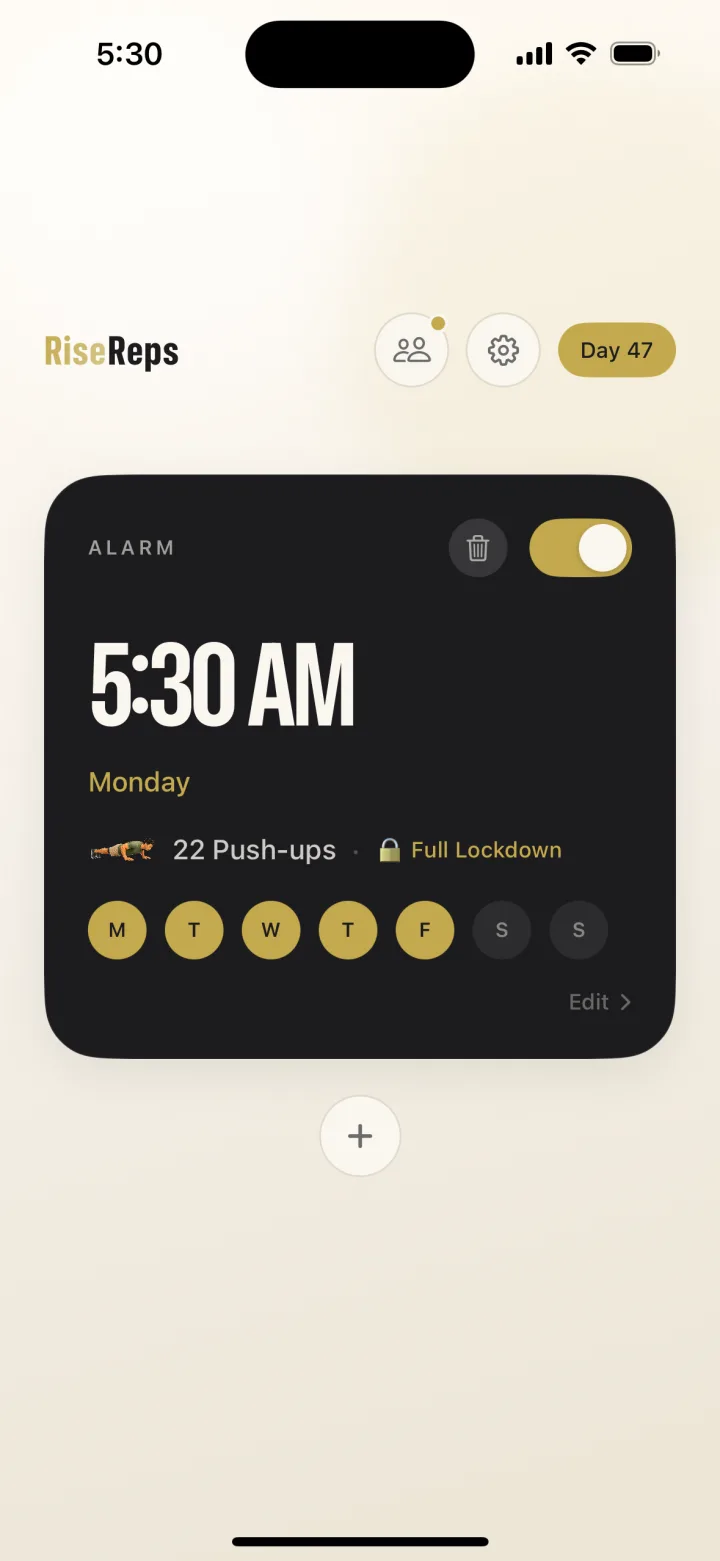
That's the gap we built RiseReps to close. When the alarm fires, your iPhone's camera counts a set of push-ups, squats or jumping jacks using on-device pose detection, and the alarm only stops when your reps are done. There's no snooze button and no tap-to-dismiss. Persistent mode re-fires every 60 seconds if you close the app, and optional Full Lockdown blocks your other apps until you finish, so the morning scroll can't start before the reps do. Nothing is recorded or uploaded. It's free to download on the App Store.
9. Shift by 15 to 30 minutes, not two hours
If you're used to 1:30 a.m., an 11 p.m. bedtime tomorrow will fail. Move it 15 to 30 minutes earlier and hold that for a few nights before moving again. Track one simple thing, like whether you were in bed by your target, and look at the week rather than any single night. Slipping once isn't failing. Slipping and then "making up for it" by sleeping until noon is what resets the clock.
Revenge bedtime procrastination and ADHD
"Is revenge bedtime procrastination an ADHD thing?" is one of the most common questions people search. There isn't a study that answers it directly, so we won't pretend there is. What we can say: the 2022 meta-analysis linked bedtime procrastination with lower self-control and an evening chronotype, and a 2017 systematic review of 62 studies in Attention Deficit and Hyperactivity Disorders by Coogan and McGowan found consistent evidence linking ADHD with later chronotypes and delayed sleep onset. So it would make sense if it hits harder, but it isn't a symptom checklist item.
The fixes above tend to help even more with ADHD because they lean on structure rather than in-the-moment willpower: an external wind-down alarm, the phone physically out of the bedroom, a fixed wake time, and an alarm you can't dismiss on autopilot. Our guide on how to get out of bed in the morning has more on ADHD mornings. Questions about treatment belong with your doctor.
When to talk to a doctor
Revenge bedtime procrastination on its own isn't a sleep disorder. But talk to a doctor if you go to bed and still can't fall asleep for long stretches, if your sleep is stuck very late no matter what you try, if you sleep a full night and still feel exhausted, or if someone notices you snore loudly or stop breathing in your sleep. The same goes if the late nights feel tied to low mood, anxiety or burnout. Those deserve real support, not just a better bedtime routine.
FAQ
What is revenge bedtime procrastination?
It's choosing to stay up later than you meant to, even though you're tired and nothing is stopping you from going to bed, because the late hours feel like the only free time you get. The phrase came from a translation of a Chinese expression about long work hours that left no time for yourself.
Why do I revenge bedtime procrastinate?
Usually because the day didn't feel like yours. Research links bedtime procrastination with lower self-control, a night-owl body clock, and draining days, and people often describe it as wanting time for themselves or simply losing track of time on their phone.
Is revenge bedtime procrastination bad?
The occasional late night is normal. Doing it most nights is linked with shorter sleep, worse sleep quality and more daytime fatigue. The CDC recommends 7 or more hours of sleep for adults 18 to 60, and late-night scrolling usually comes straight out of that.
Is revenge bedtime procrastination a sleep disorder?
No. It's a behaviour, not a diagnosis, and it isn't the same as insomnia. With bedtime procrastination you could fall asleep but don't go to bed. If you go to bed and can't fall or stay asleep, or you stay up because you fear lying awake, talk to a doctor.
How do I stop revenge bedtime procrastination?
Give your evening protected me-time with a clear end, set a wind-down alarm 30 to 60 minutes before bed, charge your phone outside the bedroom, and keep the same wake time every day. Then make mornings worth getting up for, so the night isn't your only free time.
Sources
- Kroese F. M., De Ridder D. T. D., Evers C., Adriaanse M. A. (2014). Bedtime procrastination: introducing a new area of procrastination. Frontiers in Psychology, 5. Full text.
- Nauts S., Kamphorst B. A., Stut W., De Ridder D. T. D., Anderson J. H. (2019). The explanations people give for going to bed late: a qualitative study of the varieties of bedtime procrastination. Behavioral Sleep Medicine, 17. Abstract.
- Kamphorst B. A., Nauts S., De Ridder D. T. D., Anderson J. H. (2018). Too depleted to turn in: the relevance of end-of-the-day resource depletion for reducing bedtime procrastination. Frontiers in Psychology, 9. Full text.
- Hill V. M., Rebar A. L., Ferguson S. A., Shriane A. E., Vincent G. E. (2022). Go to bed! A systematic review and meta-analysis of bedtime procrastination correlates and sleep outcomes. Sleep Medicine Reviews, 66. Abstract.
- Hill V. M., Ferguson S. A., Vincent G. E., Rebar A. L. (2024). 'It's satisfying but destructive': a qualitative study on the experience of bedtime procrastination in new career starters. British Journal of Health Psychology, 29. Abstract.
- Hill V. M., Ferguson S. A., Rebar A. L., Meaklim H., Vincent G. E. (2025). A randomised pilot trial for bedtime procrastination: examining the efficacy and feasibility of the Reducing Evening Screen Time online intervention (REST-O). Sleep Medicine, 129. Abstract.
- Magalhães P., Cruz V., Teixeira S., Fuentes S., Rosário P. (2020). An exploratory study on sleep procrastination: bedtime vs. while-in-bed procrastination. International Journal of Environmental Research and Public Health, 17. Full text.
- Coogan A. N., McGowan N. M. (2017). A systematic review of circadian function, chronotype and chronotherapy in attention deficit hyperactivity disorder. Attention Deficit and Hyperactivity Disorders, 9. Abstract.
- Sleep Foundation. Revenge Bedtime Procrastination.
- Centers for Disease Control and Prevention. About Sleep.