Every few months you decide this is it. You're going to be a morning person. You set the alarm for 6, buy the nice coffee, maybe watch a video of someone journaling at sunrise. Three days later you're back to 9:40, hair wet, eating toast in the car.
If that's you, the good news is that learning how to be a morning person isn't about willpower or a perfect routine. It's about moving your body clock, and your body clock responds to a short list of things: when you see light, when you wake, when you eat and when you move. Get those right and mornings stop feeling like a fight. Get them wrong and no 5 a.m. routine will save you.
To become a morning person, pick one wake time and keep it every day, weekends included. Get outdoor light within an hour of waking and keep evenings dim. Move your bedtime earlier along with your wake time so you don't cut sleep. Eat breakfast soon after waking and dinner earlier. Move your body in the morning. In a 2019 study, night owls who did this shifted about 2 hours earlier in three weeks. The hard part is the first ten minutes, so use an alarm you can't switch off half-asleep.
Can you become a morning person?
Short answer: yes, most people can move a fair way earlier. Whether you'll ever feel like a lark is a separate question.
Your genes set a starting point
Your chronotype, the time of day your body naturally wants to sleep and be alert, is partly inherited. In a 2019 study in Nature Communications, Jones and colleagues found hundreds of DNA regions linked to it (we covered the numbers in our guide on how to wake up early). But the effect of any one person's genes on bedtime is smaller than most people assume. Genes nudge you. They don't lock you in.
Your environment does a lot of the rest
In everyday life, a big chunk of "I'm a night owl" comes from light. Researchers have a name for the gap between the clock your body runs on and the clock your job runs on: social jetlag. In a 2006 paper in Chronobiology International, Wittmann, Dinich, Merrow and Roenneberg surveyed 501 people and described how late chronotypes show the biggest difference in sleep timing between workdays and free days. They build up sleep debt during the week and pay it back on weekends.
That pay-back is the trap. Sleep in until 11 on Saturday and your body clock drifts later, so Monday's alarm hits you like a flight to another time zone. Then you crawl through the week and do it again. Plenty of "I'm just not a morning person" is really a weekly jetlag loop.
Can a night owl become a morning person?
The research says late types actually move the most when you change their light. In a 2013 study in Current Biology, Wright and colleagues took people camping with only natural light. Their body clocks shifted earlier, and the later chronotypes shifted the most, ending up much closer to the early birds. A strong night owl may never love 5 a.m. Going from 10 a.m. to 7 a.m., though, is very realistic.
What actually changed for real night owls
The best real-world test of this is a small randomized trial from 2019. In Sleep Medicine, Facer-Childs, Middleton, Skene and Bagshaw recruited 22 healthy night owls. On average, they went to bed around 2:30 a.m. and woke around 10:15 a.m. These were serious owls.
For three weeks, the group following the plan was asked to:
- Wake up 2 to 3 hours earlier than usual and get as much outdoor light as possible in the morning.
- Go to bed 2 to 3 hours earlier and limit light in the evening.
- Keep the same sleep and wake times on workdays and free days.
- Eat breakfast as soon as possible after waking, have lunch at the same time each day, and skip dinner after 7 p.m.
The study's abstract says the interventions also targeted caffeine intake and exercise.
The result: participants shifted their sleep and wake times about 2 hours earlier, measured with wrist trackers and hormone markers, with no drop in how long they slept. They also reported less stress and fewer feelings of depression, and their reaction time and grip strength improved in the morning, the time of day when night owls usually struggle most.
Two caveats so we don't oversell it. It was 22 people over three weeks, so it's a promising result, not the final word. And nobody in it did anything clever. No supplements, no biohacks, no 4:30 a.m. ice baths. Just light, timing and consistency.
How to be a morning person: the 3-week plan
This is the study's recipe turned into something you can actually follow, plus the one piece it doesn't cover: getting out of bed when the alarm goes.
Before you start: pick your target and do the math
Choose the wake time you want to keep for the long run, not a heroic one. Then count back. The CDC recommends 7 or more hours of sleep for adults 18 to 60. If you want to wake at 6:30, you need to be asleep by about 11:30, which means lights out a bit before that. (Targeting 5am? The bedtime table in our guide on how to wake up at 5am does the math for you.) Becoming a morning person by sleeping less isn't becoming a morning person. It's becoming a tired person who's up early.
Week 1: move your wake time and guard the morning light
- Set one wake time for all seven days. If your target is more than an hour earlier than now, step it back 30 to 60 minutes every few days instead of jumping straight there.
- Get outside within an hour of waking. A walk, coffee on the step, a bike ride to work. Daylight is far brighter than indoor lighting, even when it's cloudy.
- Don't fight for an early bedtime yet. Get up on time and let the sleepiness build. You'll probably feel rough for a few days. That's the clock moving, not proof that you're "not built for this."
Week 2: dim the evenings and fix your meal times
- Lower the lights after dinner. Lamps instead of ceiling lights, and screens down or dimmed in the last hour before bed. Evening light is what drags your clock later.
- Eat breakfast soon after you wake, lunch at the same time daily, and finish dinner earlier. The study used 7 p.m. as the cutoff.
- Keep caffeine to the morning. Late coffee makes the earlier bedtime harder to hit.
- Start moving bedtime earlier now that you're actually sleepy at night. If you're tired but still stay up for some "me time," that's revenge bedtime procrastination, and our guide has fixes that don't cost you the free time.
Week 3: lock it in, especially on weekends
- Hold the wake time on Saturday and Sunday. This is where most attempts fall apart. A lie-in until 11 gives your clock a dose of late light and a late start, the exact opposite of what you've been training all week. If you need to catch up, nap early in the afternoon or go to bed a little earlier instead.
- Add movement in the morning. In a 2019 study in The Journal of Physiology, Youngstedt, Elliott and Kripke found that an hour of moderate exercise at 7 a.m. shifted the body clock earlier, while exercise between 7 and 10 p.m. shifted it later. You don't need an hour, but morning is the right time to move if you're trying to become a morning person.
The part every plan skips: the alarm
You can do all of the above and still lose the battle at 6:30 a.m. In the first minutes after waking your brain is still partly asleep (that's sleep inertia), and that's exactly when you decide whether to get up. A groggy brain will happily tap "stop" and sleep another hour. One snooze-and-sleep-in morning on a Saturday quietly undoes the weekend rule above.
So make the alarm do the deciding. Put it across the room, turn snooze off, or use an alarm that only stops once you're actually up. Our guide on how to stop hitting snooze covers the full list of fixes.
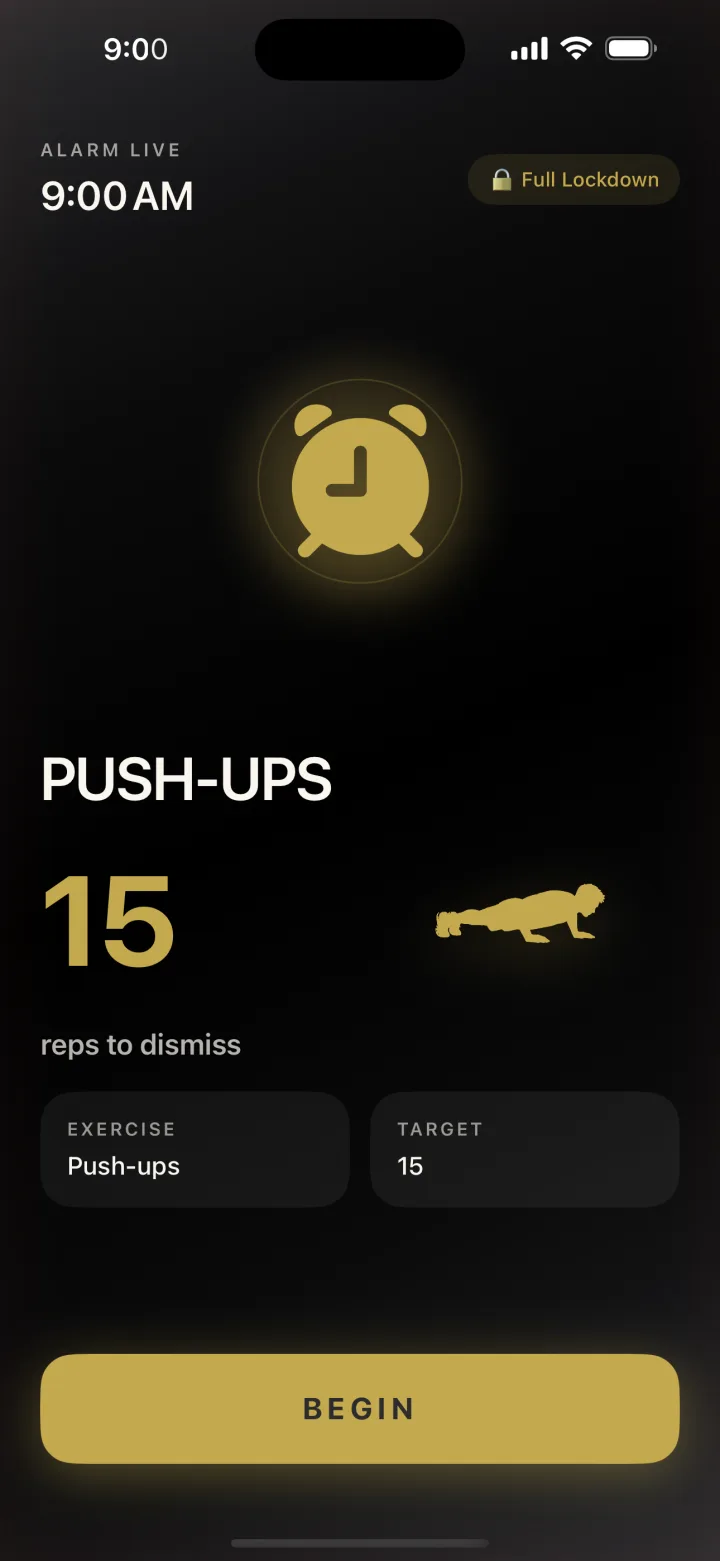
RiseReps only goes quiet when your iPhone's camera counts your push-ups, squats or jumping jacks. No snooze, no tap-to-dismiss, and Persistent mode re-fires every 60 seconds if you bail. Counting happens on your device, nothing uploaded.
How long does it take to become a morning person?
Plan on about three weeks for a real shift, based on the Facer-Childs study. In practice it tends to go like this:
- Days 1 to 4: the worst part. You're waking before your clock wants to and you're not yet sleepy early. Expect to feel flat in the afternoon.
- Week 2: bedtime starts to feel natural earlier. Mornings are still slow, but less of a shock.
- Week 3 and on: the new wake time stops feeling like an event. This is also when people slide back, usually through weekends.
That's not a promise for everyone. A bigger jump, a later starting point or a very late-lit evening routine can take longer. If you want to go faster, the study is a reminder that the levers stack: light, wake time, meals and movement all pushing the same way move you further than any one of them alone.
How to be a morning person and love it
"How to become a morning person and love it" is a rising search on Google right now, and fair enough. Getting up early is only half of it. Plenty of people manage 6 a.m. and still hate every second until noon. A few things make the mornings worth having.
Give the morning a job you actually want
If the first thing waiting for you is email, of course your brain resists. Put something there you'd look forward to on a Saturday: a proper breakfast, 20 minutes of a book, a podcast on a walk, a game you only play before 8. You're teaching yourself that early = good, not early = work.
Move first, scroll later
Moving right after you wake doesn't make you a genius, but it does help you feel more awake. In a 2021 study in Physiology & Behavior, Kovac and colleagues woke 15 people in the lab and had them do a 30-second cycling sprint, a gentle 30-second ride, or nothing. After the sprint they felt less sleepy, though their scores on thinking tests didn't change. Thirty seconds of real effort is enough to stop the "just five more minutes" spiral.
How to become a morning workout person
If your version of a morning person is someone who trains before work, start embarrassingly small. Ten push-ups or twenty squats beside the bed counts. Lay your clothes out, keep the first session under ten minutes, and add a little each week. The habit is "I move when I get up," not "I do a 60-minute session at 6 a.m." Once that's automatic, growing the workout is easy (our guide to push ups every day has a simple 4-week plan). Our guide to the alarm that makes you do push-ups shows how some people fold this straight into waking up.
Watch the streak, not the mood
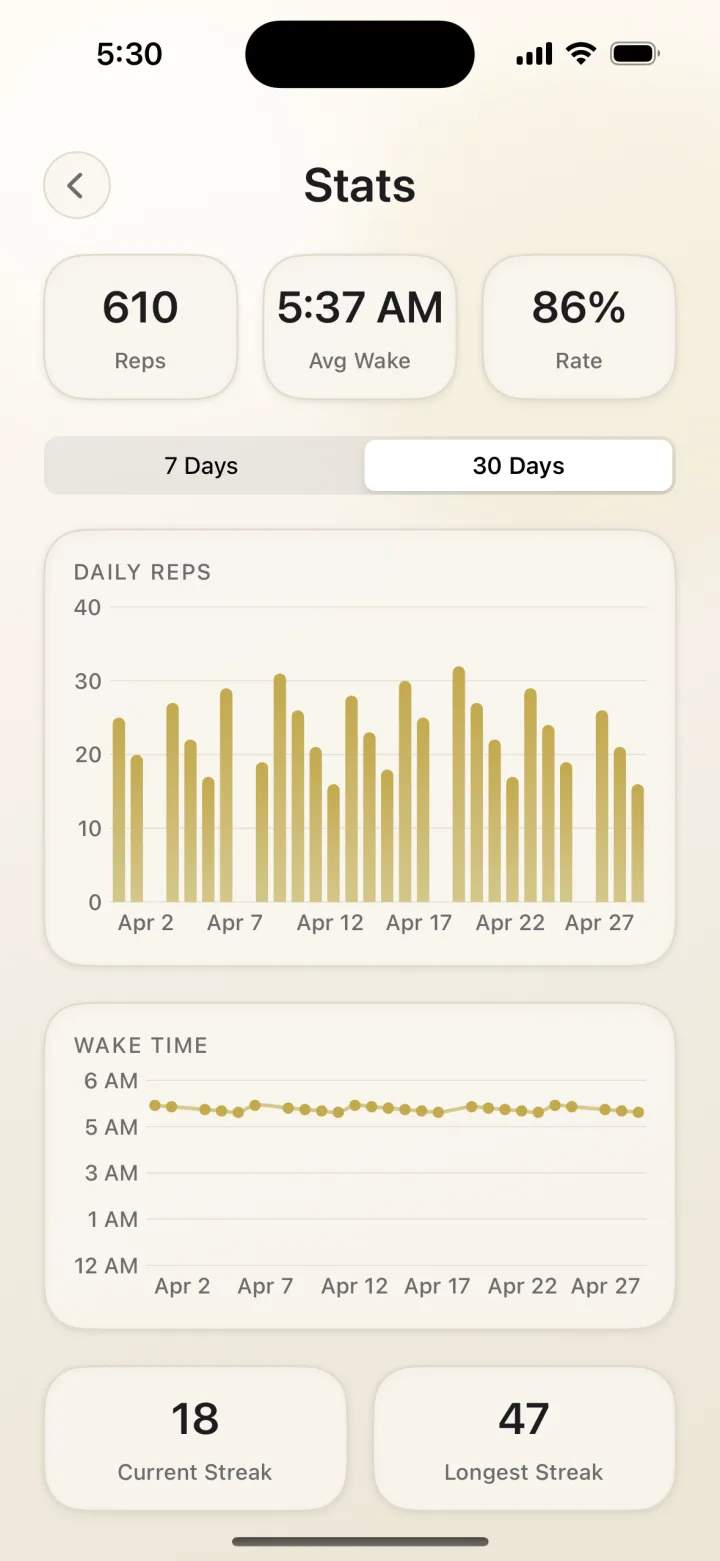
Some mornings will feel great and some will feel awful, and how you feel at 6:15 a.m. is a terrible guide to whether it's working. Track something simple instead: did you get up at your time? A visible streak gives you a reason to get up on the mornings when motivation doesn't show.
Tell one person
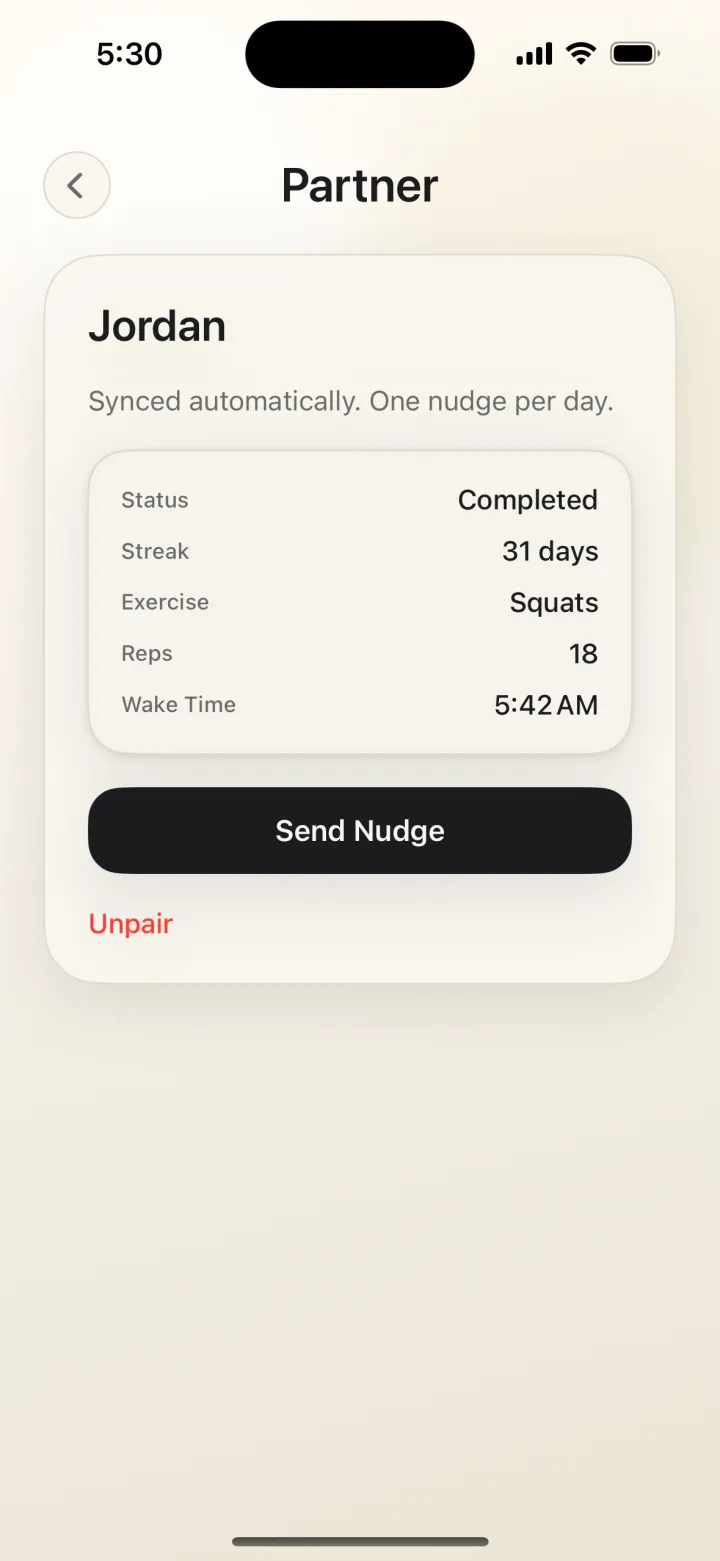
Being accountable to a single friend beats announcing it to the internet. Pick someone who'll notice if you skip, ideally someone trying the same thing.
The alarm that does the hard part for you
Everything above shifts your clock. The alarm decides whether you act on it. That's why we built RiseReps: when the alarm fires, your iPhone's camera counts a set of push-ups, squats or jumping jacks, and the alarm only stops when your reps are done. There's no snooze button and no tap-to-dismiss. Persistent mode re-fires the alarm every 60 seconds if you close the app, and optional Full Lockdown blocks your other apps until you finish. Counting uses on-device pose detection, so nothing is recorded or uploaded.
It lines up with the rest of this plan, too. You're up, you've moved, and you're far less likely to drift back to bed. Built-in progression raises your reps each week, your stats track wake time, completion rate and streaks, and you can pair with one accountability partner who sees your streak and can send one nudge a day. RiseReps is free to download on the App Store.
How to be a morning person with ADHD
If you have ADHD and mornings feel harder for you than for everyone else, there may be a reason. In a 2017 systematic review in Attention Deficit and Hyperactivity Disorders, Coogan and McGowan looked at 62 studies and found consistent evidence linking ADHD with later chronotypes and later body-clock timing.
That doesn't mean the plan won't work. It means it might take longer, and that structure matters even more. Things that tend to help: one fixed wake time, light first thing, putting the phone out of reach of the bed, laying out everything for the morning the night before, and an alarm that can't be dismissed on autopilot. Our guide on how to get out of bed in the morning has more on ADHD mornings. Treatment questions are for your doctor, not a blog.
When to see a doctor
Being a night owl is normal. But if your sleep is stuck very late no matter what you try, you sleep a full night and still feel exhausted, you regularly can't stay awake during the day, or someone notices you snore loudly or stop breathing in your sleep, talk to a doctor. The same goes if low mood or no motivation is what keeps you in bed. Some of those are treatable sleep or health problems, and no routine can fix them for you.
FAQ
Can you train yourself to be a morning person?
Yes, within limits. Your genes set a starting point, but light, wake time, meals and movement all move your body clock. In a 2019 study, night owls who kept fixed sleep times, got morning light and ate on a set schedule shifted about 2 hours earlier in three weeks.
How long does it take to become a morning person?
Expect a few weeks, not a few days. In the Facer-Childs study, night owls moved their sleep and wake times about 2 hours earlier over three weeks. The first week is usually the hardest, and the change only holds if you keep the same wake time on weekends too.
Can a night owl become a morning person?
Most can move earlier. A strong night owl may never love 5 a.m., but research shows late types shift the most when they get more morning light and less evening light. Being a night owl today doesn't mean you're stuck there.
Can you be a morning person with ADHD?
It's often harder, because research links ADHD with later body clocks, but the same tools still apply: a fixed wake time, morning light, dim evenings and an alarm you can't switch off on autopilot. If late sleep is affecting your life, talk to your doctor.
How do I know if I am a morning person?
Look at what you do on free days with no alarm. If you naturally fall asleep and wake up early and feel sharpest before noon, you lean morning. If you drift later on weekends and come alive in the evening, you lean night owl.
Sources
- Facer-Childs E. R., Middleton B., Skene D. J., Bagshaw A. P. (2019). Resetting the late timing of 'night owls' has a positive impact on mental health and performance. Sleep Medicine, 60. Abstract; University of Birmingham summary.
- Jones S. E. et al. (2019). Genome-wide association analyses of chronotype in 697,828 individuals provides insights into circadian rhythms. Nature Communications, 10. Full text.
- Wittmann M., Dinich J., Merrow M., Roenneberg T. (2006). Social jetlag: misalignment of biological and social time. Chronobiology International, 23. Abstract.
- Wright K. P., McHill A. W., Birks B. R., Griffin B. R., Rusterholz T., Chinoy E. D. (2013). Entrainment of the human circadian clock to the natural light-dark cycle. Current Biology, 23. Full text.
- Youngstedt S. D., Elliott J. A., Kripke D. F. (2019). Human circadian phase-response curves for exercise. The Journal of Physiology, 597. Full text.
- Kovac K., Vincent G. E., Paterson J. L., Reynolds A., Aisbett B., Hilditch C. J., Ferguson S. A. (2021). The impact of a short burst of exercise on sleep inertia. Physiology & Behavior, 242. Abstract.
- Coogan A. N., McGowan N. M. (2017). A systematic review of circadian function, chronotype and chronotherapy in attention deficit hyperactivity disorder. Attention Deficit and Hyperactivity Disorders, 9. Abstract.
- Centers for Disease Control and Prevention. About Sleep.