Most advice on how to wake up early boils down to "go to bed earlier and stop hitting snooze." That's true, and about as useful as "just save more money." If it were that simple, you'd already be doing it.
The real problem is that your alarm and your body clock disagree. Move the alarm alone and you fight your own biology every morning. Move the clock with it, and early starts stop feeling like a punishment. This guide covers both: how to shift your internal timing, and how to make sure you actually get up when the alarm rings.
To wake up early, move your wake time 15 to 30 minutes earlier at a time instead of all at once, and keep it the same seven days a week. Get bright light, ideally outdoors, soon after waking, and keep evenings dim. Give yourself 7+ hours in bed, and use an alarm you can't switch off from bed. Expect it to take a few weeks before it feels normal.
Why waking up early is so hard (it's not just laziness)
If 6 a.m. feels like being dragged out of a pool, there are usually a few reasons stacked together.
Your genes nudge you, a little
Some people really are built for mornings. In a 2019 study in Nature Communications, Jones and colleagues looked at genetic data from 697,828 people and found 351 regions of DNA linked to being a morning person. The 5% of people carrying the most "morning" variants slept, on average, 25 minutes earlier than the 5% carrying the fewest.
Notice the size of that. Twenty-five minutes is real, but it's not the gap between a 5 a.m. runner and someone who can't function before 9. Most of that gap comes from habits and light, and those you can change.
Modern light pushes your clock later
Your body clock sets itself mainly by light. Indoors, you get too little of it during the day and plenty of it at night. In a 2013 study in Current Biology, Wright and colleagues took a small group of people camping with no electric light. After a week of only natural light, their internal clocks ran about 2 hours earlier. The biggest shifts happened in the night owls, whose timing moved closer to that of the early birds.
You don't need to move into a tent. But it shows your "I'm just not a morning person" timing is partly a product of your lighting.
Your weekends undo your weekdays
Up at 6:30 Monday to Friday, then asleep until 10 on Saturday and Sunday? Your clock drifts later every weekend, so Monday's alarm lands in what your body still thinks is the middle of the night. We cover this "social jetlag" in Why Do I Sleep Through My Alarms?
You're cutting sleep, not shifting it
The CDC recommends 7 or more hours a night for adults aged 18 to 60. If you set the alarm an hour earlier but still fall asleep at 12:30, you haven't become an early riser. You've just slept an hour less, and your body will collect on that debt by Wednesday.
The alarm is too easy to beat
Even with perfect timing, the first few minutes after an alarm are foggy. If one tap ends it, that tap will happen. More on that below, and in How to Stop Hitting Snooze: 11 Fixes That Actually Work.
How to train your body to wake up early
This is the part most guides skip. You're not just setting a new alarm. You're shifting when your body expects to be awake. These are the levers that move it.
1. Pick one wake time and keep it every day
Your wake time is the anchor. The CDC's healthy sleep habits list starts with going to bed and getting up "at the same time every day." Weekends included. If that sounds grim, aim for within an hour of your weekday time. A big Saturday lie-in costs you more on Monday than it gives you on Saturday.
2. Get bright light soon after you wake
Morning light is the strongest signal you can give your clock that the day has started. Open the curtains as soon as you're up. Better, get outside for a few minutes: walk the dog, drink your coffee on the step, walk to the bus. Daylight, even on a cloudy morning, is much brighter than your kitchen lights.
3. Keep evenings dim
The flip side of the camping study: light late at night pushes your clock later. Lower the lights after dinner, turn your screen brightness down, and follow the CDC's suggestion to turn off devices at least 30 minutes before bed. You don't need to live in a cave. You need your evenings to look more like evenings.
4. Move in the morning
Light isn't the only signal. In a 2019 study in The Journal of Physiology, Youngstedt, Elliott and Kripke had 99 adults do an hour of moderate treadmill exercise at one of eight times of day, three days in a row. Exercise at 7 a.m., and in the early afternoon, shifted body clocks earlier. Exercise from 7 to 10 p.m. shifted them later.
To be fair to the research, that was an hour on a treadmill, not a quick set of squats, so don't expect the same effect from five minutes. But the direction is useful: morning movement works with an earlier schedule, and hard late-night workouts can work against it.
5. Let bedtime follow your wake time
Forcing yourself into bed at 9:30 when you're wide awake usually means lying there scrolling. Instead, move your wake time first and protect it. After a few days of earlier mornings and brighter light, you'll get sleepy earlier. Then go to bed when that sleepiness shows up, not two hours later.
6. Watch caffeine and alcohol
The CDC suggests avoiding caffeine in the afternoon and evening, and avoiding large meals and alcohol before bed. A 4 p.m. cold brew or a nightcap won't ruin you once. Every day, it makes an earlier bedtime harder.
A 4-week plan to wake up early
Jumping from 7:30 to 5:30 overnight is how most early-riser attempts die by day three. Move in small steps instead. Here's a plan for shifting about an hour and a half. Need a bigger shift? Add more weeks. Aiming for 5am specifically? Our guide on how to wake up at 5am has the bedtime math and a day-by-day step-down table.
| Week | Wake time | Focus |
|---|---|---|
| 1 | 30 min earlier than now | Same time all 7 days. Outdoor light within the first hour. Screens off 30 min before bed. |
| 2 | Another 30 min earlier | Go to bed when you feel sleepy, which should now be earlier. Add a short burst of movement right after waking. |
| 3 | Another 30 min earlier | Protect the weekend. No lie-ins more than an hour past your target. |
| 4 | Hold your target | Don't move it again. Let it set. If you're still exhausted, stay here an extra week before going earlier. |
Some people move in 15-minute steps every few days instead. That's fine too. Go slower if you're running on empty, faster if it's going smoothly. The rule is to keep the time fixed between steps, every day.
How to wake up early and not go back to sleep
You can do everything above and still lose the morning in the 30 seconds after the alarm. That's when you're least awake and most likely to negotiate. Win those 30 seconds and the rest is easy. (For a full walkthrough of that moment, see how to get out of bed in the morning.)
Put the alarm across the room
Classic advice because it works. If you have to stand up to stop it, you're already halfway there.
Turn snooze off (and know what the research really says)
Snoozing isn't poison. In a study in the Journal of Sleep Research, Sundelin, Landry and Axelsson (2024) found that 30 minutes of snoozing cost habitual snoozers about 6 minutes of sleep and didn't hurt their test scores after getting up. So if snoozing is part of a routine that works for you, fine.
But if you're reading a guide on how to wake up early, it probably isn't working. Ten snoozes turn a 6:00 alarm into a 7:10 start. Then the early wake time exists only on paper.
Make the alarm impossible to beat from bed
This is the big one. Half-asleep you is great at tapping Stop and weirdly good at math puzzles. Half-asleep you is bad at anything that needs you standing up. We ranked seven kinds of hard-to-dismiss alarms in Alarm Clock That Makes You Get Out of Bed: 7 Types Ranked. The ones that work need your body, not just your thumb.
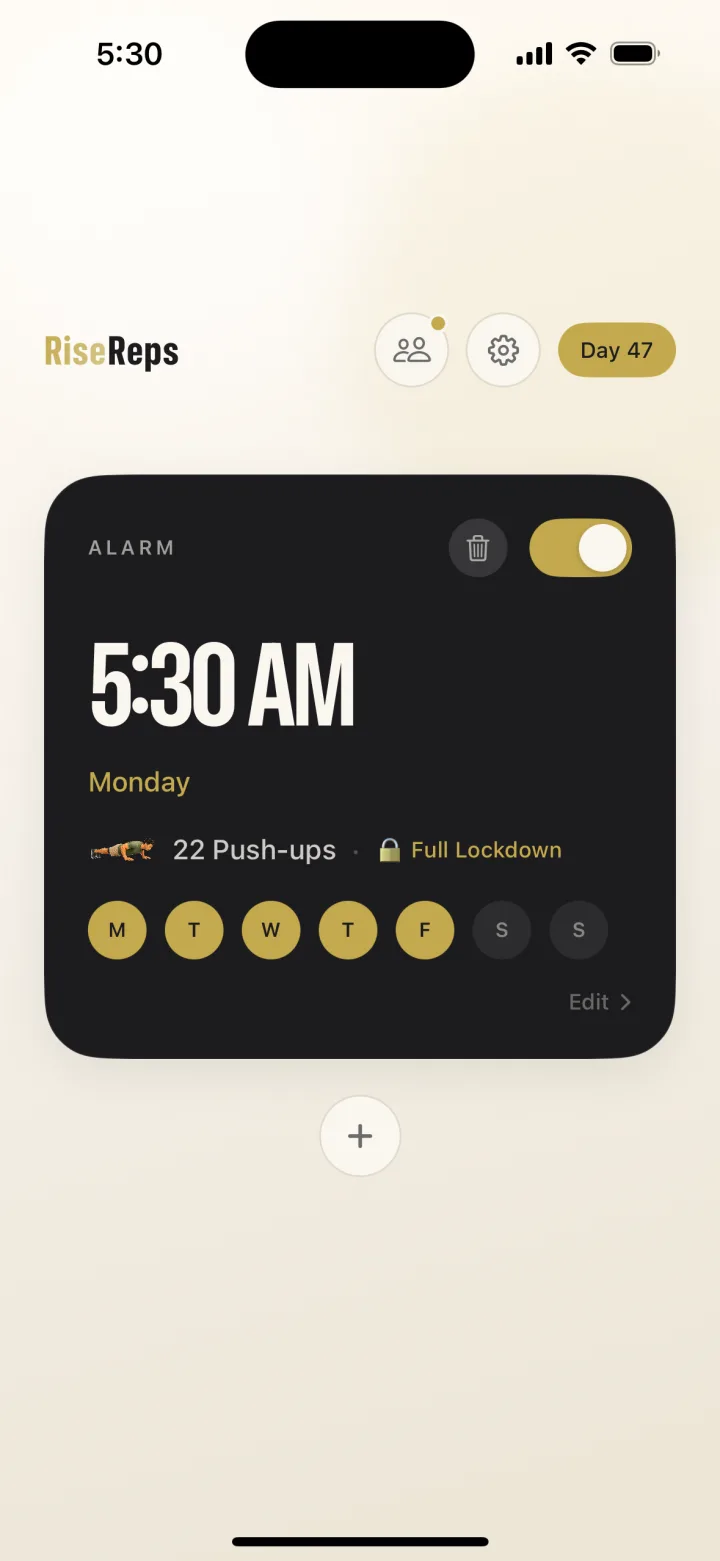
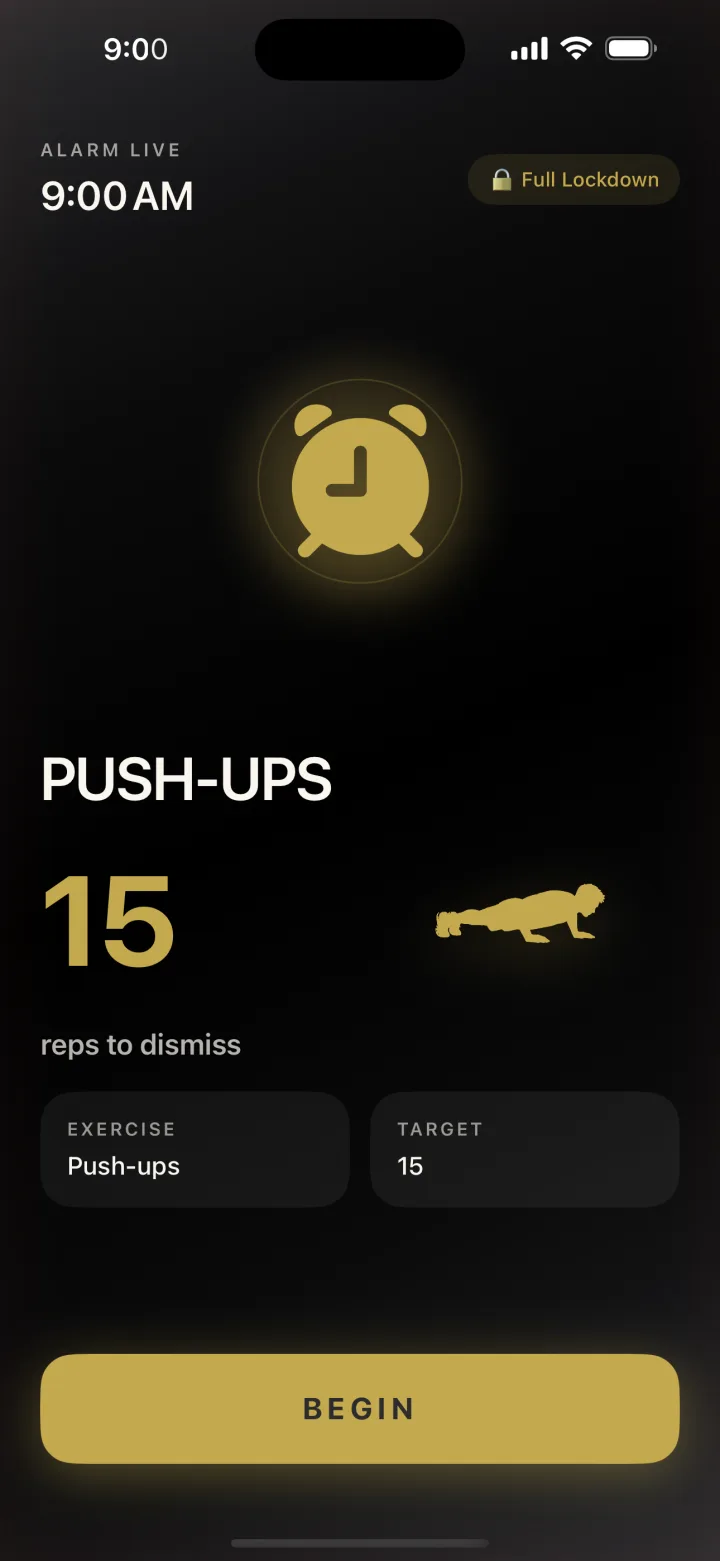
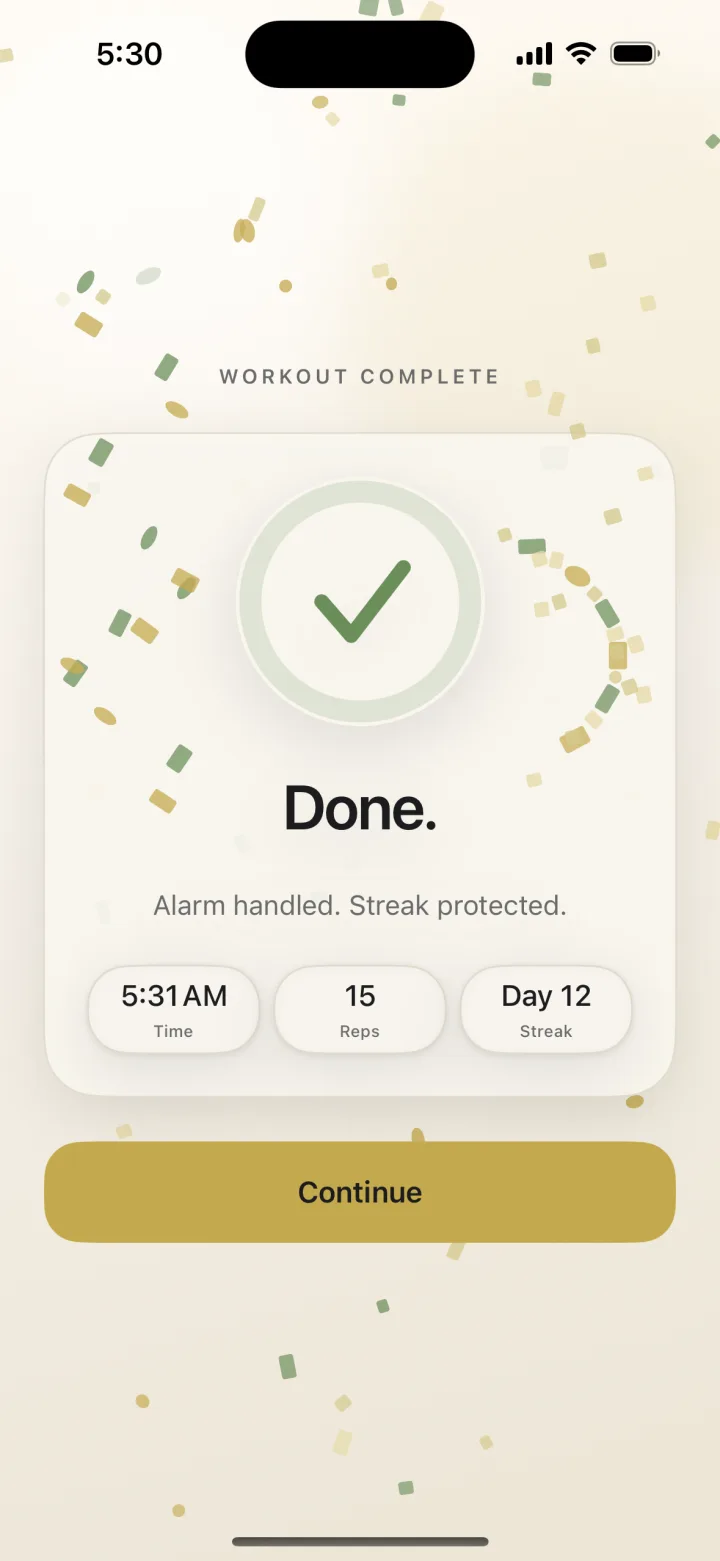
That's why we built RiseReps. When the alarm fires, your iPhone's camera counts a set of push-ups, squats, or jumping jacks, and the alarm only goes quiet when your reps are done. There's no snooze button and no tap-to-dismiss. Persistent mode re-fires the alarm every 60 seconds if you close the app, and optional Full Lockdown blocks your other apps until the workout is finished. Counting uses on-device pose detection, so nothing is recorded or uploaded. It's free to download on the App Store.
Move for 30 seconds
Movement right after waking seems to cut the "I could go back to sleep" feeling. In a 2021 lab study in Physiology & Behavior, Kovac and colleagues woke 15 people from sleep and had them do a 30-second hard bike sprint, a 30-second easy spin, or nothing. They felt least sleepy after the sprint. Their test scores didn't improve, though, so think of it as getting you up, not making you sharper.
RiseReps only stops when your camera counts your reps. No snooze, no tap-to-dismiss, and Persistent mode re-fires if you bail. Nothing recorded or uploaded.
How to wake up early to work out
"I'll wake up early and go to the gym" might be the most-broken promise in fitness. The usual problem: the alarm and the workout are two separate decisions. You make the first one at 6:00 and the second at 6:01, while you're still in bed, still warm, and very good at excuses.
Fixes that help:
- Start tiny. Ten squats you actually do beat a 45-minute plan you skip. Build the wake-up habit first, then grow the workout.
- Remove the next-morning decisions. Clothes out, shoes by the door, plan written down. Nothing to decide at 6:01.
- Make the workout part of the alarm. If the alarm only stops after a set of push-ups, the first workout of the day is already done before you can argue with it. Our push-up alarm guide covers setup and how many reps to start with.
- Let it grow slowly. RiseReps has weekly progression that can raise your rep count each week, so the habit grows without you having to plan it.
And remember the Youngstedt study: morning exercise is moving your clock in the direction you want. The workout is helping you wake up early, not just using the time.
How to wake up early as a heavy sleeper
If your problem isn't getting up but hearing the alarm in the first place, start with sound and sleep debt before anything else. A low, harsh tone tends to beat a gentle chime, and a phone under a pillow is muffled. Our best alarm app for heavy sleepers guide explains what works, including the iPhone settings that quietly silence alarm apps.
How to wake up early when you go to bed late
Two very different situations hide behind this question.
One late night. Get up at your normal time anyway. Sleeping in feels like the fix, but it pushes your clock later and makes the next night harder too. Get light early, move, keep caffeine to the morning, and if you nap, keep it short and well before evening. Then go to bed a bit earlier that night. One rough day is the price of keeping the schedule.
Every night is a late night. Then the honest answer is that you can't wake up early on five hours of sleep forever and feel fine. The fix is your bedtime, and the plan above is how you move it: earlier wake time, morning light, dimmer evenings, and going to bed when you're sleepy. If you're sleepy but stay up anyway because the late hours are the only ones that feel like yours, read our guide to revenge bedtime procrastination.
If you've kept a steady schedule for several weeks and still can't fall asleep before 2 a.m., or can't wake up no matter what, mention it to a doctor. Some people have a body clock that runs very late as a medical condition, and it's treatable.
Does waking up early get easier?
For most people, yes, once the body clock catches up. That's the whole point of the light, the consistency and the morning movement. In the camping study, the night owls shifted the most, so being a "night person" today doesn't mean you're stuck. If that's you, our guide on how to be a morning person as a night owl walks through the 3-week study that shifted night owls about 2 hours earlier.
Signs it's working:
- You sometimes wake a few minutes before the alarm.
- You feel sleepy earlier in the evening without trying.
- The first five minutes feel groggy, not brutal.
- Mondays stop feeling worse than Thursdays.
Signs to check in with a doctor: you get 7 or more hours, keep a steady schedule for weeks, and still wake up exhausted, nod off during the day, or have a partner telling you that you snore loudly or stop breathing. Waking up early shouldn't require a fight every single day. If it does, something besides your alarm may be going on.
FAQ
Does waking up early get easier?
Usually, yes. When you keep the same wake time every day and get bright light soon after waking, your body clock gradually shifts earlier, and early mornings stop feeling like the middle of the night. Most people need a few weeks of consistency. If you still feel exhausted after several weeks of 7+ hours, talk to a doctor.
How can I wake up early naturally?
Work with your body clock. Keep a fixed wake time seven days a week, get outdoor light in the first hour, keep evenings dim, and move your body in the morning. In a 2013 Current Biology study, a week of natural light only shifted people's internal clocks about 2 hours earlier.
How do I wake up early if I sleep late?
After one late night, get up at your usual time anyway, get light early, and go to bed a little earlier that night. Sleeping in pushes your clock later. If you sleep late every night, fix your bedtime by moving your wake time earlier in 15 to 30 minute steps and going to bed when you feel sleepy.
Can you train yourself to wake up early without an alarm?
Many people start waking close to their target time after weeks of a consistent schedule, enough sleep and morning light. Keep an alarm set anyway as a backup, especially for work, flights or anything you can't afford to miss.
Why is waking up early so hard?
Usually it's a mix of a body clock that runs later than your alarm, too little sleep, weekend lie-ins that shift your schedule, and an alarm that's easy to turn off half-asleep. Genes play a small part: a 2019 Nature Communications study found people with the most morning-type gene variants slept about 25 minutes earlier on average.
Sources
- Jones S. E. et al. (2019). Genome-wide association analyses of chronotype in 697,828 individuals provides insights into circadian rhythms. Nature Communications, 10. Full text.
- Wright K. P., McHill A. W., Birks B. R., Griffin B. R., Rusterholz T., Chinoy E. D. (2013). Entrainment of the human circadian clock to the natural light-dark cycle. Current Biology, 23. Full text.
- Youngstedt S. D., Elliott J. A., Kripke D. F. (2019). Human circadian phase-response curves for exercise. The Journal of Physiology, 597. Full text.
- Sundelin T., Landry S., Axelsson J. (2024). Is snoozing losing? Why intermittent morning alarms are used and how they affect sleep, cognition, cortisol, and mood. Journal of Sleep Research. Abstract.
- Kovac K., Vincent G. E., Paterson J. L., Reynolds A., Aisbett B., Hilditch C. J., Ferguson S. A. (2021). The impact of a short burst of exercise on sleep inertia. Physiology & Behavior, 242. Abstract.
- Centers for Disease Control and Prevention. About Sleep.