Most people who try to wake up at 5am do it the same way. They set the alarm two hours earlier on a Monday, go to bed at the usual time, feel like a zombie by Wednesday and quietly give up by Friday. The goal was fine. The method was a crash diet for sleep.
Waking up at 5am isn't a personality trait. It's a schedule, and schedules can be moved. This guide covers the math first (what time to go to bed), then a step-down plan that gets you to 5am in about three weeks, then the part most guides skip: what to do in the first five minutes, when your brain is foggy and very good at negotiating.
How do you wake up at 5am? Work backwards from 7 or more hours of sleep: be asleep by about 10pm, which means in bed around 9:30 to 9:45pm. Move your alarm 15 minutes earlier every two or three days instead of jumping straight to 5am, and move bedtime with it. Keep the same wake time on weekends (within about an hour). Get bright light soon after waking, and make the alarm something you can't turn off from bed, so the first decision of the day is already made.
What time should I go to bed to wake up at 5am?
Start here. Your wake time is only as good as the bedtime behind it.
The American Academy of Sleep Medicine and the Sleep Research Society reviewed the evidence in a joint consensus statement published in Sleep (Watson and colleagues, 2015). Their recommendation: adults should sleep 7 or more hours per night on a regular basis.
So count back from 5:00. And count back from when you're actually asleep, not when you get into bed. Almost nobody falls asleep the second their head hits the pillow, so the "in bed by" column below adds a 20-minute buffer. That buffer is our rule of thumb, not a medical number; adjust it if you know you fall asleep faster or slower.
| Sleep you want | Asleep by | In bed, lights out by |
|---|---|---|
| 7 hours (the minimum) | 10:00pm | 9:40pm |
| 7.5 hours | 9:30pm | 9:10pm |
| 8 hours | 9:00pm | 8:40pm |
| 9 hours | 8:00pm | 7:40pm |
Yes, 9:40pm feels absurd if you're used to midnight. That's the real cost of a 5am alarm, and it's better to see it now than at 2pm on Thursday. If a 9:40pm lights-out will never happen in your life, a 5:30 or 6:00 wake time with enough sleep beats 5:00 without it.
How much sleep do you need to wake up at 5am?
The same amount you need to wake up at 8am. Getting up earlier doesn't shrink your sleep need; it just moves the window.
Is waking up at 5am good for you?
Here's the honest answer: there's nothing magic about 5:00 itself. We couldn't find any study showing that 5am risers do better than 6:30 risers who get the same sleep. What the research does support is enough sleep and a regular schedule.
Regularity gets less attention than it deserves. In a 2017 study in Scientific Reports, Phillips and colleagues tracked 61 college students for 30 days. The students with the most irregular sleep had body clocks running much later than regular sleepers (their melatonin rose more than two hours later, on average), got less daytime light, and had lower grades. The authors' model suggested the difference came mainly from their light exposure patterns. It was observational, so it doesn't prove cause and effect, but a wake time that jumps around seems to drag your clock later.
That means a steady 5am, seven days a week, with enough sleep, can work well. A 5am alarm on weekdays and noon on Saturday is closer to flying between time zones every week.
Does waking up at 5am make you more productive?
It can, but not because of the hour. The real benefit is quiet, uninterrupted time: no messages, no meetings, nobody asking for anything. If you spend 5:00 to 6:00 scrolling in bed, you've gained nothing except tiredness. Decide what the hour is for before you start. A 5am wake-up without a job for that hour rarely survives the second week.
How to get used to waking up at 5am
Your body clock can shift, but it shifts gradually. Jumping two hours overnight is why the first week feels terrible. Step down instead: move your alarm 15 minutes earlier every two or three days, and move your bedtime by the same amount. Here's what that looks like from a 7:00am start:
| Days | Alarm | Lights out (7 hrs + buffer) |
|---|---|---|
| 1–3 | 6:45am | 11:25pm |
| 4–6 | 6:30am | 11:10pm |
| 7–9 | 6:15am | 10:55pm |
| 10–12 | 6:00am | 10:40pm |
| 13–15 | 5:45am | 10:25pm |
| 16–18 | 5:30am | 10:10pm |
| 19–21 | 5:15am | 9:55pm |
| 22+ | 5:00am | 9:40pm |
Three weeks sounds slow. It's faster than the usual pattern of starting over every Monday. If a step feels rough, stay on it for a few extra days instead of skipping ahead. And if you're a true night owl who currently falls asleep at 1am, start from wherever you are now and expect it to take longer; our guide on how to be a morning person walks through what shifted real night owls earlier and how fast.
Start right after the clocks fall back
If you live somewhere that uses daylight saving time, the November switch is the easiest moment to start (in the US, clocks fell back on November 1 this year). The morning after the change, 5:00 on the clock feels like 6:00 to a body still running on the old time. Instead of letting your schedule drift an hour later over the next week, keep your old body-clock wake time and you've banked a free hour of the step-down plan.
How to wake up at 5am everyday (weekends included)
"How to wake up at 5am everyday" is the top related search for this topic, and "everyday" is the hard part. Most early-rising plans don't fail on Tuesday. They fail on Saturday.
Sleeping in on weekends feels like recovery, but it pushes your clock later right before Monday. Researchers call the gap between your workday and free-day sleep times social jetlag. In a 2006 paper in Chronobiology International, Wittmann, Dinich, Merrow and Roenneberg surveyed 501 people and found that late chronotypes had the biggest gap between workdays and free days, building up sleep debt during the week that they paid back on weekends. The authors linked that mismatch to poorer wellbeing and more smoking, especially in teens and young adults.
How fast can a weekend undo your progress? A 2017 study in Current Biology by Stothard and colleagues gives a hint from the other direction. People who spent a single summer weekend camping with only natural light shifted their body clocks earlier, achieving about 69% of the shift seen after a full week of camping. If two days of light can move your clock that much earlier, two days of late nights and blackout curtains can move it later just as fast.
Practical rules for weekends:
- Keep your wake time within about an hour on days off. 5am on weekdays, 6am at the latest on Saturday.
- Nap instead of sleeping in if you're short on sleep. A short early-afternoon nap protects tomorrow's wake time better than a 9am lie-in.
- Plan something for Saturday at 5am. A run, the farmers' market, a long breakfast. Without a reason, the weekend alarm gets switched off.
- Get outside in the morning. Daylight is the strongest signal your body clock gets, which is the main lesson of both camping studies.
How to wake up at 5am without feeling tired
Some grogginess at 5am is normal. Sleep researchers call it sleep inertia: the slow, foggy period right after waking when your thinking and reaction time are worse than they'll be later. A 2019 review in Nature and Science of Sleep by Hilditch and McHill notes that it fades the longer you're awake, and that it gets worse with prior sleep loss and when you wake at a bad time for your body clock. Both of those describe someone who jumped to 5am overnight.
What helps, in order of how much it matters:
- Enough sleep. Nothing else on this list fixes six hours. Go back to the bedtime table.
- The same wake time every day. A regular schedule means your body starts preparing to wake before the alarm, instead of being dragged out of the middle of its night.
- Bright light soon after waking. At 5am in fall and winter it's dark outside, so turn on bright overhead lights, and step outside once the sun is up. Morning light pulls your clock earlier; late-evening screens and bright rooms push it later. Our guide on how to wake up early covers the light research in more depth.
- Get vertical and move. Standing up and doing something physical for a minute shakes off the fog faster than lying in bed with your phone.
What about snoozing?
The research here is more forgiving than the internet. In a 2024 study in the Journal of Sleep Research, Sundelin, Landry and Axelsson found that 30 minutes of snoozing didn't hurt habitual snoozers' performance on cognitive tests right after getting up, and cost them about 6 minutes of sleep. So a snooze button isn't poison. The problem at 5am is different: you snooze once, then again, and the 5am plan becomes a 6:40am rush. If your goal is to actually use that early hour, our guide on how to stop hitting snooze has 11 fixes.
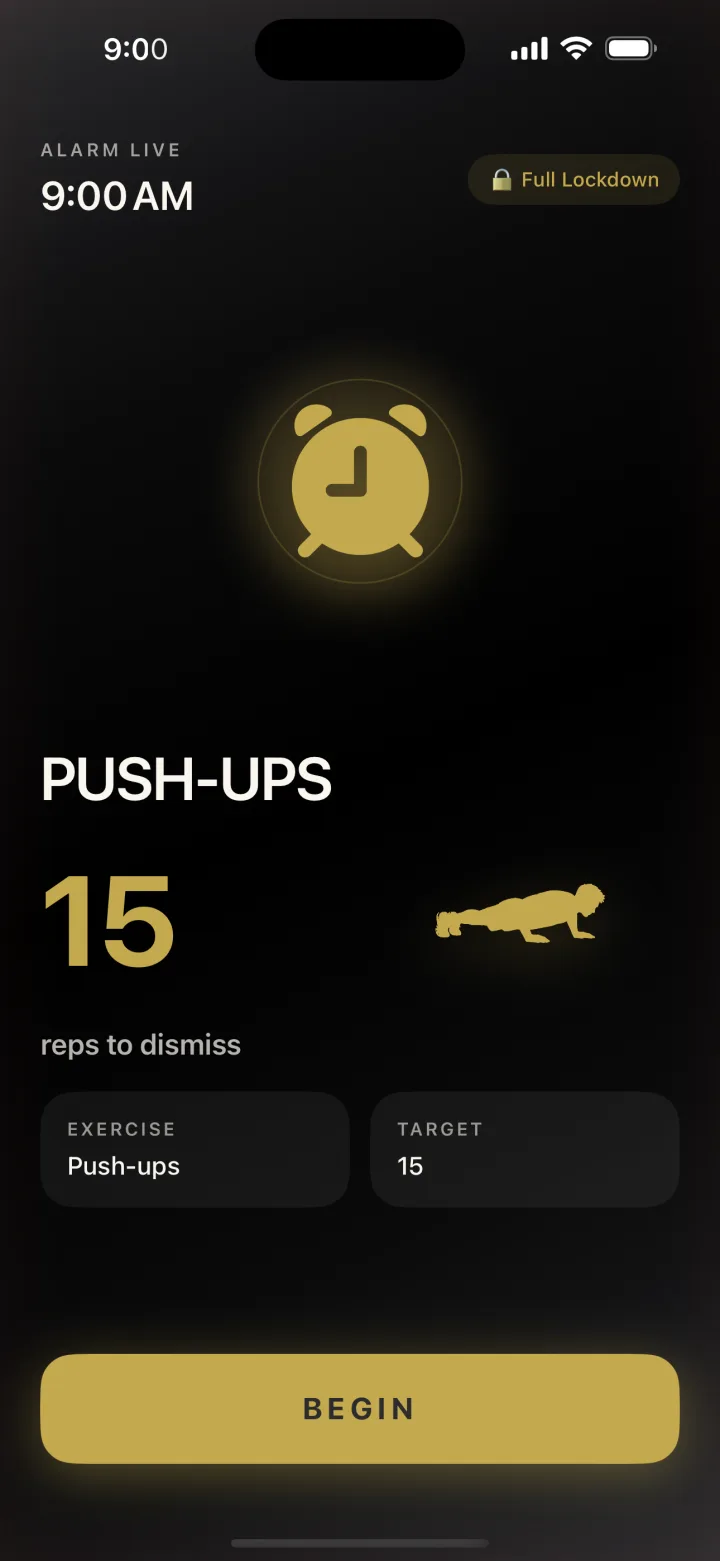
RiseReps only goes quiet when your iPhone's camera counts your push-ups, squats or jumping jacks. No snooze, no tap-to-dismiss, and Persistent mode re-fires every 60 seconds if you bail. Counting happens on your device, nothing uploaded.
The first five minutes at 5am
You can get the bedtime right and still lose the whole plan in one moment: the alarm goes off, it's dark, the bed is warm, and a groggy brain decides whether you get up. That's the weakest link in every 5am routine.
The fix is to make the decision the night before and give your half-asleep self nothing to negotiate with:
- Put the phone across the room. Getting up to turn it off does half the work.
- Lay out the first ten minutes. Clothes on the chair, shoes by the door, water on the counter. Fewer choices, fewer excuses.
- One alarm, at the real time. A 4:40, 4:50 and 5:00 alarm stack trains you to ignore alarms.
- Make the first action physical. Feet on the floor, lights on, and move for a minute before you look at anything on a screen.
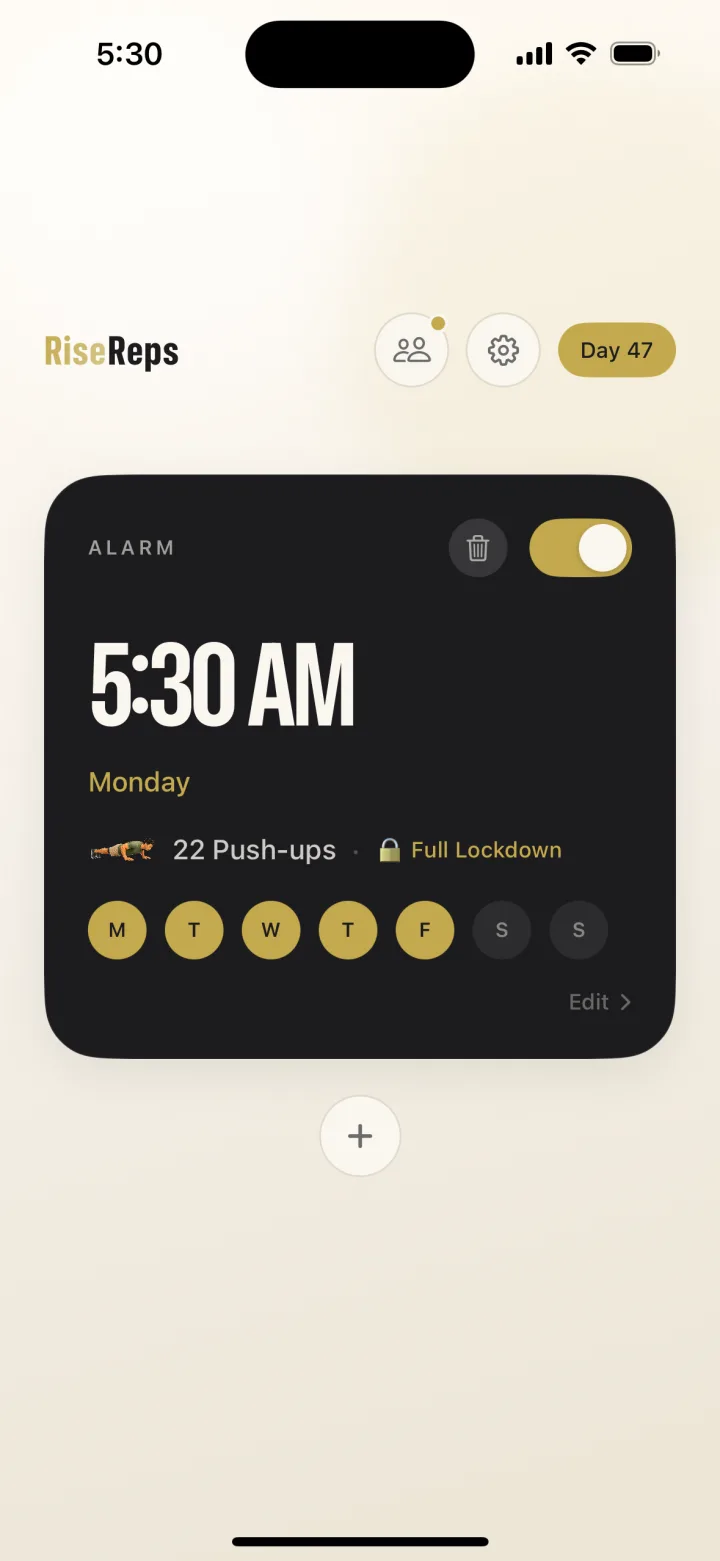
That last rule is exactly what RiseReps is built around. When your alarm fires, the camera counts a set of push-ups, squats or jumping jacks using on-device pose detection, and the alarm only stops when your reps are done. There's no snooze button and no tap-to-dismiss. Persistent mode re-fires the alarm every 60 seconds if you close the app, and optional Full Lockdown blocks your other apps until the workout is done, so 5am doesn't turn into 5am on Instagram. By the time it goes quiet, you're standing up, your heart rate is up, and the hard part of the morning is over. RiseReps is free to download on the App Store, and the alarm workouts need RiseReps Pro, a single annual subscription.
How to wake up at 5am to workout
Training is one of the best jobs for a 5am hour, and the reasons go beyond "the gym is empty." Exercise doesn't just wake you up; it also nudges your body clock. In a 2019 study in The Journal of Physiology, Youngstedt, Elliott and Kripke had 99 adults do an hour of moderate treadmill exercise at different times of day for three days. Exercise at 7am, and in the afternoon, shifted their body clocks earlier, while exercise from 7pm to 10pm shifted them later. That's an hour-long session, not a quick set, but it points the same way: morning movement helps an early schedule stick, and hard late-evening workouts work against it.
You don't need an hour at 5am to benefit from the habit. A realistic start:
- Minute 0–2: a set of push-ups, squats or jumping jacks to get up and out of the fog.
- Minute 2–10: water, light on, dressed.
- Minute 10 onward: the real workout, a walk or run outside once it's light, or whatever the hour is for.
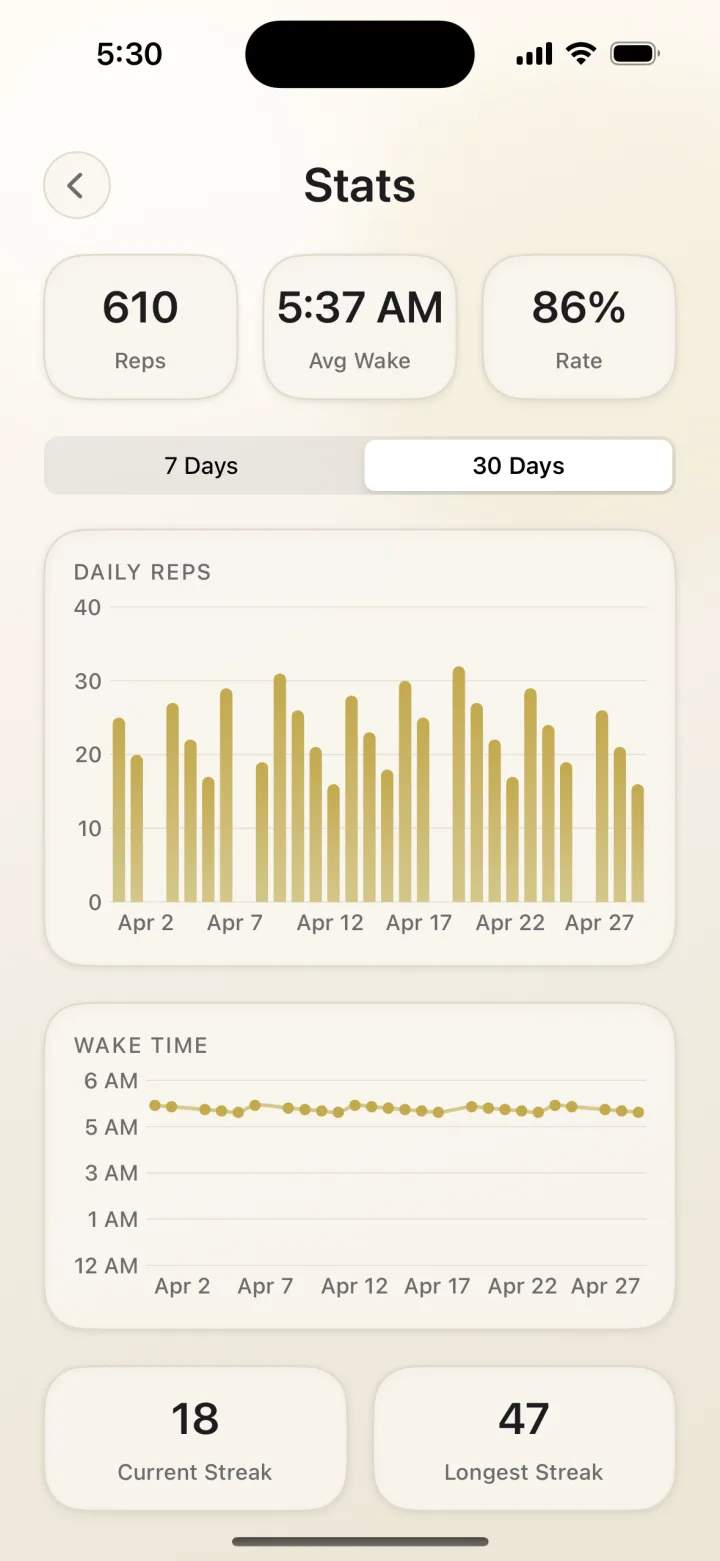
If daily push-ups are your thing, our guide to push ups every day covers how many to start with and how to progress. RiseReps' built-in progression can raise your rep count each week, and your streak, wake times and completion rate log themselves, so you can see whether 5am is actually sticking instead of guessing.
Tell one person
A 5am habit is easier with a witness. RiseReps lets you pair with one accountability partner: you see each other's streaks and wake stats, and either of you can send one nudge a day when the other sleeps in. No feed, no leaderboard. Just someone who'll notice if 5:00 became 7:30.
Why do I wake up at 5am without an alarm?
A different problem, but a common search. Some everyday reasons:
- Your body clock has shifted earlier, often from early bedtimes, early light or a long-running early schedule.
- Light gets into the room, especially in summer when the sun rises early.
- Noise, heat, a partner or a pet starting their day.
- Alcohol in the evening, which can disrupt sleep later in the night.
- Stress, or needing the bathroom.
Blackout curtains, a cooler room and a later, consistent bedtime help many people. But if you regularly wake far earlier than you want, can't get back to sleep and feel worn out during the day, or it comes with low mood, that's worth raising with a doctor rather than troubleshooting alone.
FAQ
What time should I go to bed to wake up at 5am?
For 7 hours of sleep, be asleep by 10pm, which usually means in bed with the lights out around 9:30 to 9:45pm. For 8 hours, be asleep by 9pm. Sleep experts recommend 7 or more hours a night for adults, so count back from when you actually fall asleep, not from when you get into bed.
How do I get used to waking up at 5am?
Move your alarm 15 minutes earlier every two or three days instead of jumping straight to 5am, and move your bedtime by the same amount. From a 7am start that takes about three weeks. Keep your wake time within about an hour on weekends so Saturday doesn't undo the week.
How do I wake up at 5am without feeling tired?
Get at least 7 hours by moving bedtime earlier, keep the same wake time every day, turn on bright lights soon after waking and move your body in the first few minutes. Some grogginess right after waking is normal sleep inertia and fades the longer you're up.
Is waking up at 5am good for you?
Only if you still get enough sleep. There's nothing special about 5am itself; what the research supports is 7 or more hours of sleep on a regular schedule. If 5am means cutting your sleep to five or six hours, a later wake time is the healthier choice.
Why do I wake up at 5am without an alarm?
Common reasons include a body clock that has shifted earlier, light or noise in the room, alcohol in the evening, stress or needing the bathroom. If you often wake much earlier than you want, can't get back to sleep and feel exhausted during the day, talk to a doctor.
Sources
- Watson N. F., Badr M. S., Belenky G., et al. (2015). Recommended amount of sleep for a healthy adult: a joint consensus statement of the American Academy of Sleep Medicine and Sleep Research Society. Sleep, 38. Full text.
- Phillips A. J. K., Clerx W. M., O'Brien C. S., Sano A., Barger L. K., Picard R. W., Lockley S. W., Klerman E. B., Czeisler C. A. (2017). Irregular sleep/wake patterns are associated with poorer academic performance and delayed circadian and sleep/wake timing. Scientific Reports, 7. Full text.
- Wittmann M., Dinich J., Merrow M., Roenneberg T. (2006). Social jetlag: misalignment of biological and social time. Chronobiology International, 23. Abstract.
- Stothard E. R., McHill A. W., Depner C. M., et al. (2017). Circadian entrainment to the natural light-dark cycle across seasons and the weekend. Current Biology, 27. Full text.
- Hilditch C. J., McHill A. W. (2019). Sleep inertia: current insights. Nature and Science of Sleep, 11. Full text.
- Sundelin T., Landry S., Axelsson J. (2024). Is snoozing losing? Why intermittent morning alarms are used and how they affect sleep, cognition, cortisol, and mood. Journal of Sleep Research, 33. Abstract.
- Youngstedt S. D., Elliott J. A., Kripke D. F. (2019). Human circadian phase-response curves for exercise. The Journal of Physiology, 597. Full text.