If you keep asking "why do I sleep through my alarms?", the answer is usually one of two very different things. Either the sound never really reached you, or it did, and a half-asleep version of you switched it off and went back under. Most people assume the first. Often, it's the second.
The fixes point in opposite directions. Better sound helps the first group. A harder way to turn the alarm off helps the second. So start with a quick test to see which camp you're in, then match the fix to the cause.
You usually sleep through alarms because of sleep debt, a body clock that runs later than your alarm, or sleep inertia that lets you turn the alarm off on autopilot. Alcohol, sedating medications, a sound you've tuned out, and sleep disorders like sleep apnea can add to it. The fix: protect 7+ hours, keep a steady wake time, use a lower, harsher sound, and pick an alarm you can't dismiss from bed.
First: did you not hear it, or did you turn it off?
You can't fix the right thing until you know which problem you have. Run this for three mornings:
- Put the phone across the room, out of arm's reach, with snooze off.
- In the morning, check where it is and what state it's in. If the alarm was stopped and the phone moved, you got up and switched it off. If it rang out untouched, you likely never registered it.
Rang out and you never stirred? You're in the "didn't hear it" group. Focus on sound, sleep debt, alcohol and medical causes below.
Turned off with no memory of it? You're in the "autopilot" group. Your hearing is fine. Your problem is that the alarm is easy to beat while you're still mostly asleep.
Why do I sleep through my alarms? 8 causes
Most people have two or three of these stacked together.
1. You're running on a sleep debt
This is the big one. The CDC has reported that about 1 in 3 US adults don't regularly get the 7+ hours recommended. When you're short, your body's drive to stay asleep is stronger, and the grogginess after waking is worse too. A 2019 review of sleep inertia research puts it plainly: "Sleep inertia is worse under conditions of prior sleep loss."
Tell-tale sign: you wake fine on holidays and weekends, but not after a week of 6-hour nights.
2. Your alarm goes off in your biological night
Your body clock doesn't care what your calendar says. If you naturally fall asleep at 1 a.m., a 6 a.m. alarm is landing in the middle of your night. The same review found that sleep inertia is "greatest during the biological night," near the low point of your body temperature rhythm.
For some people this is a diagnosable circadian rhythm disorder. The American Academy of Sleep Medicine notes that delayed sleep-wake phase disorder affects about 7% to 16% of teens and young adults, with symptoms that include trouble falling asleep at a normal bedtime and an "inability to wake up in the morning." More often, it's simply a late schedule that drifts further every weekend, which researchers call social jetlag: the mismatch between your internal clock and the hours your life demands.
Tell-tale sign: you're wide awake at midnight and useless at 7 a.m., and Monday is always the worst.
3. Sleep inertia puts you on autopilot
The first minutes after waking aren't really "awake." The 2019 review found that performance often recovers within about 30 minutes, but "full recovery does not appear to be complete until at least an hour after awakening." In that fog, simple, well-practised actions still work fine. Reaching for a phone and tapping Stop is about as practised as it gets.
That's why so many people find their alarm switched off with no memory of it. You didn't sleep through it. You handled it while your judgment was still offline. (Our full guide to sleep inertia covers how long it lasts and how to shake it faster.)
Tell-tale sign: the alarm is off, the phone has moved, and you have zero memory of it.
4. Your brain has learned to ignore the sound
Hear the same tone every morning for a year and it stops sounding like an emergency. The sound itself matters too. In a 2009 study in the Journal of Sleep Research, low-pitched square-wave tones (around 400 to 520 Hz) woke people from deep sleep at lower volumes than other signals, including a high-pitched smoke alarm beep. A gentle, high chime is close to the worst choice if you're a deep sleeper.
Tell-tale sign: an unfamiliar sound wakes you instantly; your usual alarm doesn't.
5. Snooze has trained you to go back to sleep
If your alarm routine is "ring, snooze, ring, snooze," you've practised dismissing the alarm every single morning. To be fair, research doesn't show snoozing is harmful for everyone (see How to Stop Hitting Snooze: 11 Fixes That Actually Work). But it's one more easy exit.
6. You drank the night before
Alcohol is one of the best-studied reasons people don't wake to alarms, mainly because fire-safety researchers care a lot about it. A 2011 paper in the Journal of Studies on Alcohol and Drugs sums up the research: alcohol "significantly reduces the likelihood of waking to a smoke alarm." It cites a study in which 38.5% of young adults at a 0.05% blood alcohol level slept through a 75 dBA high-pitched alarm. With a 520 Hz square-wave tone, that dropped to 0%. Small studies, but the direction is clear.
7. Medications or sleep aids are still working
Sedating sleep aids and some prescription medications can leave you heavier in the morning, especially if taken late. Don't change a prescription on your own, but do ask your doctor or pharmacist whether timing could be the issue.
8. A sleep disorder is fragmenting or deepening your sleep
Sometimes the alarm isn't the problem at all. A few conditions are known for making waking unusually hard:
- Sleep apnea. According to the NINDS disorder summary, its hallmark symptom is excessive daytime sleepiness, along with loud snoring with pauses and gasps, morning headaches and trouble concentrating. You can spend 8 hours in bed and wake up as if you slept 4.
- Idiopathic hypersomnia. The Hypersomnia Foundation notes that people with it often have severe sleep inertia ("sleep drunkenness") that can last up to a few hours, and "may need multiple loud alarms."
- Delayed sleep-wake phase disorder, covered in cause #2.
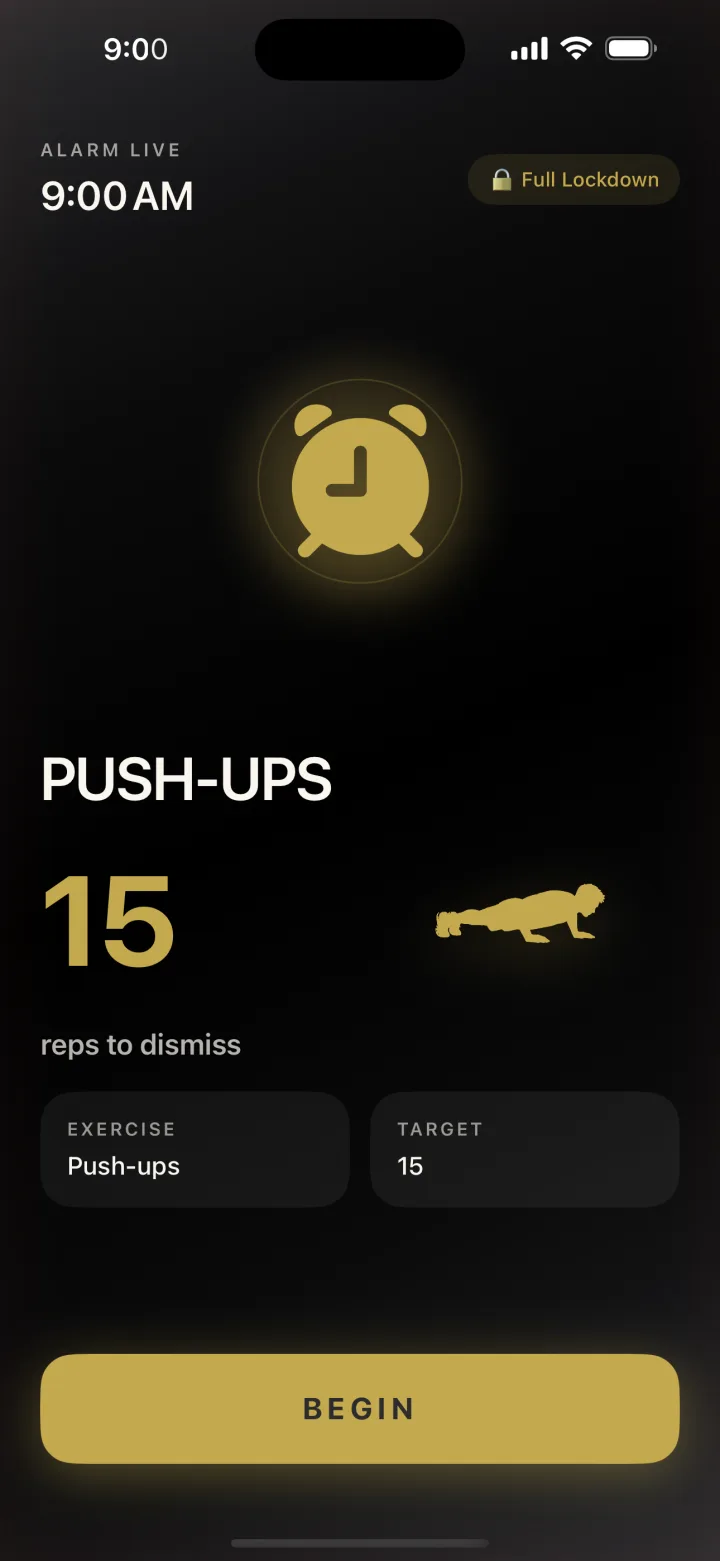
RiseReps only goes quiet when your camera counts your reps. No snooze, no tap-to-dismiss, and Persistent mode re-fires every 60 seconds if you close the app. Counting happens on-device. Nothing is recorded or uploaded.
Sleeping through alarms all of a sudden?
If you used to wake up fine and now you don't, look for what changed recently:
- Sleep: later bedtimes, late-night scrolling, a run of short nights.
- Schedule: an earlier alarm than usual, a time zone change, shift work, or weekends that drift later and later.
- Substances: more alcohol than usual, a new medication or dose, a new sleep aid.
- Health: illness, recovery, stress, low mood, new snoring that a partner has noticed.
- Your phone: a Sleep or Do Not Disturb Focus that now silences your alarm app, or an alarm permission you declined. Our guide to alarm apps for heavy sleepers explains what iOS 26 changed and what to check.
If nothing on that list changed, raise it with a doctor.
How to stop sleeping through your alarms
Match the fix to the cause. Here's the short version:
| Cause | Fix that matches it |
|---|---|
| Sleep debt | Protect 7+ hours; move bedtime earlier before moving the alarm |
| Late body clock | Same wake time every day, bright light soon after waking, less bright light late at night |
| Autopilot dismissal | An alarm you can't stop from bed: walking, scanning, or reps |
| Tuned-out sound | A lower, harsher tone; change it when it stops working |
| Snooze habit | Snooze off, one alarm, set for when you'll actually get up |
| Alcohol or sedating meds | Earlier, lighter drinking; ask about medication timing |
| Sleep disorder | A doctor and possibly a sleep study, not an app |
If you don't hear it
- Switch to a low, buzzy sound. Based on the research above, pick a harsh, low tone over a soft, high chime.
- Rotate it. When you notice yourself sleeping through a sound, swap it for something unfamiliar.
- Move the phone, not just the volume. A phone under a pillow or face-down on a soft surface is muffled. Put it on a hard surface across the room.
- Check Focus and permissions. The quietest alarm is one your phone has silenced. If yours sounds weak even at full volume, our guide to iPhone alarm volume settings covers the hidden ones, like Attention Aware.
If you turn it off without remembering
- Remove every one-tap exit. Snooze off, and no "backup" alarm 5 minutes earlier that teaches you the first one doesn't count.
- Use an alarm that needs a task you can't do lying down. Math problems and shaking the phone can be done in bed. Walking to a QR code or doing reps can't. We ranked seven types in Alarm Clock That Makes You Get Out of Bed: 7 Types Ranked.
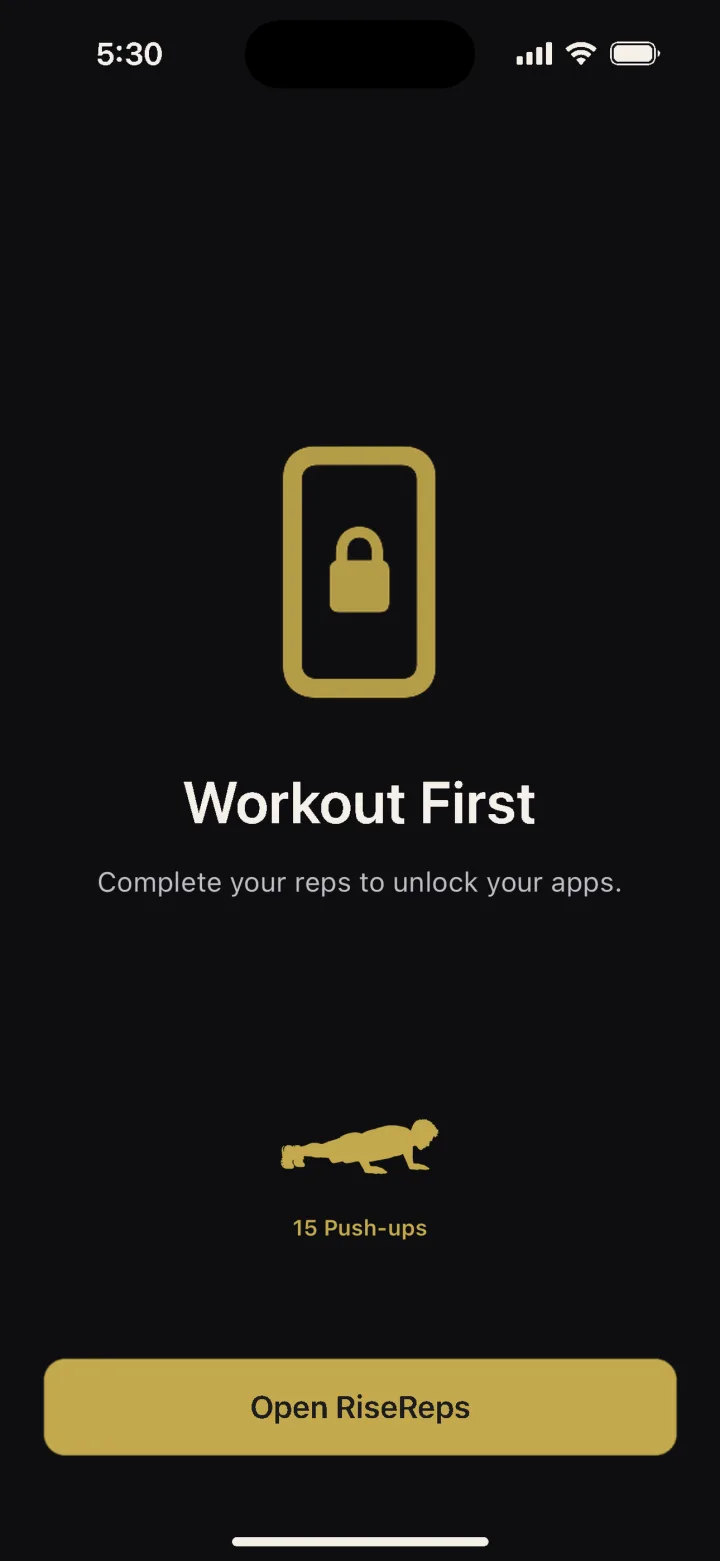
- Close the "just close the app" loophole. Look for an app that re-fires if you bail. In RiseReps, Persistent mode re-fires the alarm every 60 seconds if you close the app, and optional Full Lockdown blocks your other apps until your reps are done.
- Move for 30 seconds. In a 2021 lab study, people who did a 30-second burst of hard exercise after waking felt less sleepy than when they stayed still. Their test scores didn't change, so think of it as getting you out of bed, not making you sharper.
A camera-verified exercise alarm hits several of these at once. RiseReps counts push-ups, squats, or jumping jacks with on-device pose detection, and the alarm only stops when the reps are done. There's no snooze button. Our push-up alarm guide covers setup and how many reps to start with.
For everyone
- Keep the same wake time seven days a week, or within an hour of it. Big weekend lie-ins make Monday's alarm land in your biological night. Want to move that wake time earlier? See How to Wake Up Early: A Plan That Actually Sticks.
- Get light early, and keep screens dimmer late at night.
When to talk to a doctor
Being a deep sleeper is common and usually harmless. But an alarm app can't diagnose anything. See a doctor if:
- You regularly sleep 7 to 9 hours and still can't wake up or feel unrefreshed.
- Someone has told you that you snore loudly, stop breathing, or gasp in your sleep.
- You wake up with headaches, or nod off in meetings, on the couch, or while driving.
- You started sleeping through alarms suddenly and nothing in your routine changed.
These conditions are treatable, and treating them will do more for your mornings than any alarm.
FAQ
Why do I sleep through my alarms all of a sudden?
Look for what changed. Common triggers are a run of short nights, a later bedtime or shifted schedule, alcohol, a new medication, illness, or stress. On iPhone, also check that a Focus mode or a missing alarm permission isn't silencing your alarm app. If nothing obvious changed and it keeps happening, talk to a doctor.
Why do I turn off my alarm and not remember doing it?
Right after waking you're in sleep inertia, a groggy state where full recovery can take an hour or more, and simple, familiar actions still work on autopilot. Tapping Stop is about as familiar as it gets. An alarm that needs a physical task away from the bed, like walking to scan a code or doing reps, makes autopilot dismissal much harder.
Can alcohol make you sleep through your alarm?
Yes. Smoke alarm research summarized in a 2011 paper in the Journal of Studies on Alcohol and Drugs found that alcohol significantly reduces the chance of waking to an alarm. In one cited study, 38.5% of young adults at a 0.05% blood alcohol level slept through a 75 dBA high-pitched alarm, while none slept through a lower 520 Hz square-wave tone.
Is sleeping through alarms a sign of a medical problem?
Usually not. Most cases come down to too little sleep, a late body clock, or an alarm that's too easy to dismiss. But if you sleep 7 to 9 hours and still can't wake, snore loudly, wake with headaches, or feel very sleepy during the day, see a doctor. Sleep apnea, idiopathic hypersomnia and delayed sleep-wake phase disorder are all treatable.
How do I stop sleeping through my alarms?
Match the fix to the cause. Get 7+ hours and keep a steady wake time, switch to a lower, harsher alarm sound and change it when you start tuning it out, put the phone across the room, turn snooze off, and use an alarm that only stops after a physical task, like camera-counted reps.
Sources
- Hilditch C. J., McHill A. W. (2019). Sleep inertia: current insights. Nature and Science of Sleep. Full text.
- Centers for Disease Control and Prevention (2016). 1 in 3 adults don't get enough sleep.
- American Academy of Sleep Medicine. Delayed sleep-wake phase.
- Roenneberg T. et al. (2012). Social jetlag and obesity. Current Biology. Summary.
- Bruck D., Thomas I., Rouillard V. (2009). How does the pitch and pattern of a signal affect auditory arousal thresholds? Journal of Sleep Research. Abstract.
- Bruck D., Ball M., Thomas I. R. (2011). Fire fatality and alcohol intake: analysis of key risk factors. Journal of Studies on Alcohol and Drugs. PDF.
- NINDS via BrainFacts.org. Sleep apnea.
- Hypersomnia Foundation. Sleep inertia.
- Kovac K. et al. (2021). The impact of a short burst of exercise on sleep inertia. Physiology & Behavior. Abstract.